
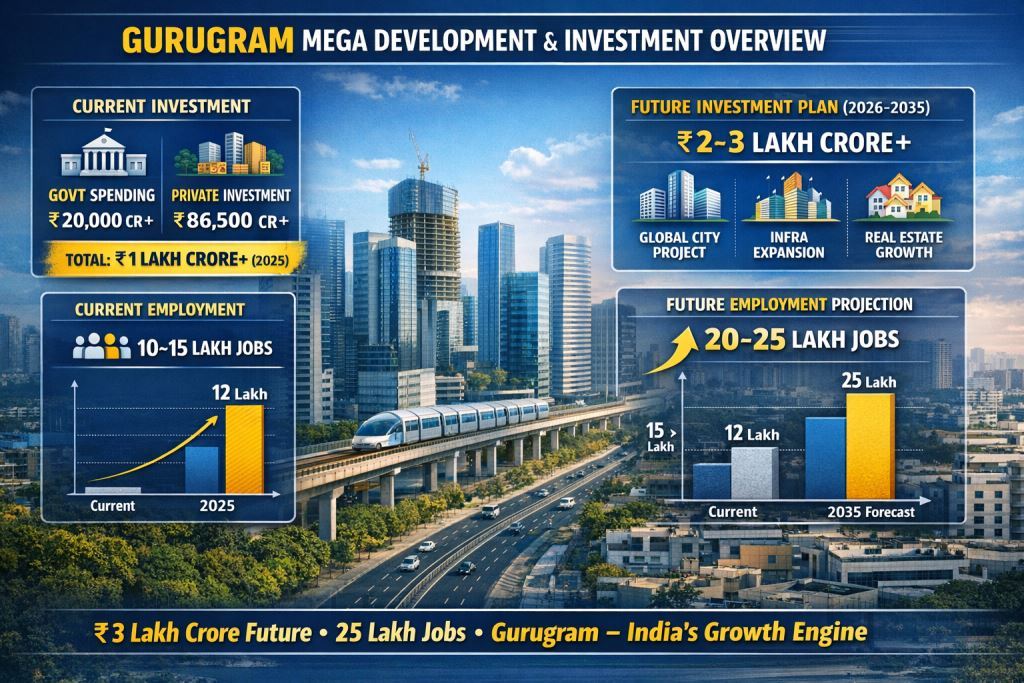
1. Historical Evolution of Gurugram
| Ancient to Medieval Roots |
| |
| Pre-1990s Phase (Rural Economy) |
| |
| Post-Liberalization Boom (1990s–2000s) |
| |
| 2000–Present: Hyper-Urban Growth |
|
|
2. Current Economic Importance
| Macro Economic Indicators | Contribution to State Economy | |
|
|
|
👉 Analysis: This indicates extreme economic concentration—Gurugram is not just a city but the financial backbone of Haryana.
Sector-wise Economic Strength
| 1. IT & ITES |
|
|---|---|
| 2. BFSI (Banking & Finance) |
|
| 3. Manufacturing & Auto |
|
| 4. Startups & Digital Economy |
|
👉 Economic Model Insight: Gurugram is a classic case of “agglomeration economics”—where companies cluster to benefit from shared infrastructure, talent, and networks.
3. Political & Governance Significance
| Strategic Location Advantage | Political Importance | 👉 Impact: |
|
|
|
4. Social & Cultural Dynamics
Urban Demographics
Highly cosmopolitan:
Migrants from across India
Large expatriate population
Lifestyle Features
High-end malls, nightlife, corporate lifestyle
However:
Weak cultural identity compared to historic cities (Hindustan Times)
Social Challenges
Urban inequality
Infrastructure gaps
Pollution issues
👉 Analysis:
Gurugram is a “corporate-first city”—economic growth outpaced social infrastructure.
5. Educational Importance
Education Ecosystem
Rapid growth of:
Private universities
International schools
Skill development centers
Role in Talent Supply
Feeds workforce to:
IT
Consulting
Finance
👉 Insight:
Education here is market-driven, aligned with corporate needs rather than traditional academia.
6. Industrial & Corporate Ecosystem
Key Industries
IT & ITES
Finance
Automobile
Real estate
Retail & hospitality
Corporate Density
Over 23,000+ companies (approx.) (Travel Food Lifestyle Zogyy.com)
👉 Cluster Effect:
High productivity
Innovation spillovers
Competitive ecosystem
7. Global Importance
Why Gurugram Matters Globally
Hosts:
Global MNC headquarters
Shared service centers
Integrated into:
Global supply chains
International outsourcing networks
👉 Position:
One of Asia’s fastest-growing corporate hubs
8. Government & Private Sector Development
Government Initiatives
Infrastructure:
Dwarka Expressway
Metro expansion
Smart city initiatives
Urban mobility improvements
Private Sector Role (Key Driver)
Real estate-led development:
Cyber City
Golf Course Road
Mega projects:
Global City Project (~1000 acres) (Business Standard)
👉 Model Insight:
Gurugram is a privately driven urbanization model—rare in India.
9. Why Gurugram is Better Than Other Cities
Comparative Advantages
| Factor | Gurugram Advantage |
|---|---|
| Location | Near Delhi & airport |
| Corporate Presence | Highest MNC density |
| Income Levels | Among highest per capita |
| Real Estate | Premium + commercial mix |
| Connectivity | NCR integration |
| Job Opportunities | Massive white-collar jobs |
👉 Compared to:
Bangalore: Better infrastructure planning (in some zones), proximity to government
Mumbai: More affordable commercial space
Hyderabad: Higher global corporate concentration
10. Real Estate Analysis & Future
Current Scenario
Strong demand in:
Luxury housing
Commercial office spaces
Driven by:
Corporate expansion
High-income professionals
Key Corridors
Golf Course Road
Dwarka Expressway
Southern Peripheral Road (SPR)
Price Drivers
Infrastructure projects
MNC demand
Limited land availability
Future of Real Estate (Data-backed Analysis)
Growth Drivers
Global City Project (1000 acres) (Business Standard)
Increasing foreign investment
Hybrid work → demand for premium homes
Expansion of metro & expressways
Forecast Trends
Commercial real estate: High growth (office demand)
Luxury housing: Strong appreciation
Rental yield: Stable due to corporate tenants
👉 Risk Factors
Infrastructure stress
Water scarcity
Pollution
11. Key Challenges (Critical Analysis)
Despite success, Gurugram faces:
Urban Planning Issues
Drainage failures
Traffic congestion
Patchy civic governance
Environmental Problems
High pollution levels
Groundwater depletion
Governance Model Issue
Over-reliance on private developers
👉 Insight:
Gurugram is both:
India’s most successful urban experiment
AND a cautionary tale of unplanned growth
12. Future Outlook (2030–2040)
Likely Trajectory
Will remain:
India’s top corporate hub
Global outsourcing capital
Expected Developments
Smart infrastructure
Green buildings
AI-driven business ecosystem
Long-Term Prediction
Could become:
India’s first true global city
But only if:
Governance + infrastructure gaps are fixed
Final Conclusion
Gurugram represents:
✔ India’s fastest urban transformation
✔ A private-sector-led economic revolution
✔ A global corporate powerhouse
But also:
⚠ Infrastructure stress
⚠ Governance challenges
⚠ Environmental risks
👉 Final Insight:
Gurugram’s success lies in economic concentration + private innovation, but its future depends on sustainable urban planning.
If you want, I can also:
Compare Gurugram vs Noida vs Bangalore (investment perspective)
Give real estate investment hotspots (sector-wise)
Or create a presentation/report for business use


Leave a Comment