
Investment Analysis, Infrastructure Projects, Employment Growth and Real Estate Future
Research-led feature article for Ghar Dhudho | Updated: 19 October 2026 | Geography: Prayagraj district, Uttar Pradesh, India


Executive summary
Prayagraj is entering an important phase of infrastructure-led development. Its future will be shaped by four major forces: improved road connectivity, investment in manufacturing, expansion of education and healthcare, and the economic opportunities created by religious tourism and urbanisation.
Government investment has already supported large development programmes. In December 2024, the Prime Minister inaugurated and launched projects worth approximately ₹5,500 crore in Prayagraj, including road and rail works, flyovers, permanent ghats, water supply, power, sewage treatment and temple corridors.
The government subsequently approved 1,168 development projects worth approximately ₹9,668 crore for Prayagraj district for 2026–27, according to reporting published in July 2026. These are approved project values, not proof that the full amount has already been spent.
The proposed Integrated Manufacturing Cluster (IMC) at Saraswati Hi-Tech City is another major development opportunity. The official industrial corridor agency lists 352 acres of project area, ₹658 crore in project cost, ₹1,600 crore in potential industrial investment and 17,700 potential jobs.
The central question is not simply how much money has been announced. It is whether the investment creates completed infrastructure, productive businesses, sustainable employment and genuine demand for property.
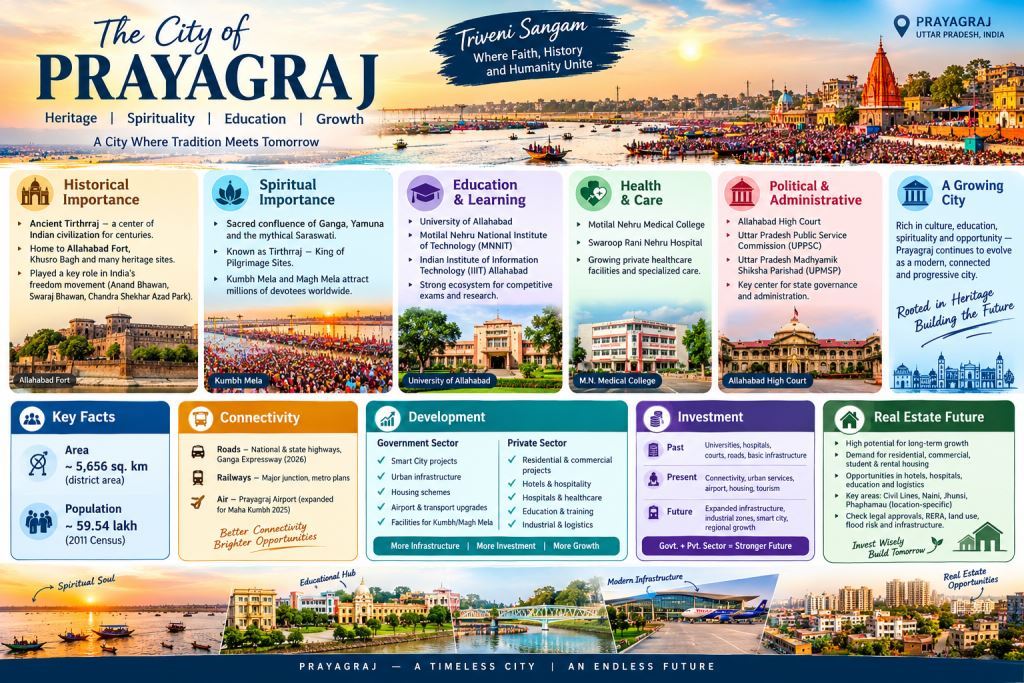
Prayagraj development at a glance

1. Research methodology: What counts as investment?
To understand Prayagraj's economic development accurately, four financial categories must be separated.
Category | Meaning | How it should be reported |
|---|---|---|
Actual expenditure | Money paid for work already completed or delivered | Verified spending |
Sanctioned project cost | Budget or project cost formally approved | Approved investment |
Proposed private investment | Capital investors have expressed an intention to deploy | Proposed investment |
Future investment scenario | Potential spending based on assumptions about growth | Forecast, not commitment |
This distinction is essential because investor summits can announce large proposals that are subsequently revised, delayed, relocated or never implemented.
A proper ten-year retrospective for 2016–2026 would need expenditure data from the central and state governments, the district administration, road and railway agencies, urban development authorities, educational institutions, healthcare providers and private companies.
Likewise, a reliable forecast for 2026–2056 requires a project-by-project pipeline. No verified consolidated official total for all government and private investment across Prayagraj district for the entire 30-year period is established by the sources cited in this article.
The analysis below therefore separates verified project values from economic opportunities and longer-term scenarios.
2. Investment over the last decade: Government versus private sector
2.1 Major published financial indicators
The following comparison brings together several publicly reported figures relevant to Prayagraj's development.
Year / period | Investment or project figure | Sector / category | Financial status |
|---|---|---|---|
2023 | ₹33,703 crore | Proposals from 108 investors at the divisional investment summit | Proposed investment; implementation not established by the announcement Lucknow News - The Indian Express |
2023 | ₹53,021.25 crore | Proposals from 278 investors reported for Prayagraj | Proposed investment; overlaps with the broader investment-promotion period and must not be added to the first figure Hindustan Times |
December 2024 | Approximately ₹5,500 crore | Maha Kumbh-linked road, rail, sanitation, water, power and religious infrastructure | Projects inaugurated and launched; the total is not necessarily all expenditure made in that year Press Information Bureau |
2026–27 | Approximately ₹9,668 crore | 1,168 district development projects | Approved project value reported in July 2026; not all expenditure confirmed as completed The Times of India
|
Industrial cluster project | ₹658 crore | IMC Prayagraj project cost | Published project cost NICDC
|
Industrial cluster project | ₹1,600 crore | Potential investment by industries in the IMC | Investment potential, not confirmed realised private investment NICDC
|
2.2 Comparative chart of selected project values
Selected Prayagraj development figures
Reported project values and investment potential in ₹ crore. These are different categories and are not additive.

Sources: PIB, NICDC and July 2026 district-development reporting.
Press Information Bureau
+2
How to read this graph: The ₹9,668 crore figure is the largest among the four selected values, but it represents a district-level approval pipeline for a particular financial year. The ₹5,500 crore figure covers a different development package, while the two IMC figures represent project cost and potential industrial investment. The graph is a comparison of scale, not a measure of actual cumulative spending.
2.3 How much of the investment is government-funded, and how much is private?
The published figures do not support an accurate government-versus-private split for all development in Prayagraj over 2016–2026.
Investment category | Government contribution | Private contribution |
|---|---|---|
Public roads, bridges, sanitation and water projects | Public project funding, potentially involving multiple agencies | Contractors may execute works, but contract value is not the same as private investment |
Industrial cluster | Published cluster-development cost of ₹658 crore | Potential industrial investment of ₹1,600 crore |
2023 investor proposals | Public incentives and supporting infrastructure may be involved | Proposals reported at ₹33,703 crore and ₹53,021.25 crore; implementation and overlap need verification |
Hospitals, universities and commercial real estate | Public facilities and eligible public funding | Private capital may fund hospitals, education, housing and commercial projects |
Residential property | Public infrastructure supports development | Builders, landowners, homebuyers and financial institutions contribute capital |
A private company constructing a government-funded road does not automatically mean the project represents private investment. Similarly, a property transaction is not necessarily new productive investment: it can simply be a transfer of ownership. To calculate a defensible decade-wide total, each project would need its location, funding source, sanctioned cost, actual expenditure, completion status and overlap with other schemes.
3. Road and highway development: Connectivity as an economic multiplier


Connectivity is one of the strongest potential catalysts for Prayagraj's development. Its economic value goes beyond faster travel: it can reduce transport costs, improve access to markets, increase the feasible commuting area and make industrial and residential locations more attractive.
3.1 Key road and transport corridors
Project / network | Main development function | Potential economic benefit | Important qualification |
|---|---|---|---|
Ganga Expressway | Long-distance road connectivity between western and eastern Uttar Pradesh | Passenger mobility, freight movement, tourism and logistics | Statewide project; only part of its benefits and expenditure can be attributed to Prayagraj |
Prayagraj Ring Road and bypass network | Movement around the urban core | Reduced through-traffic and improved access to peripheral areas | Benefits depend on completed sections, junctions and connecting roads |
National Highway network | Links Prayagraj with regional markets and other cities | Freight, commerce, passenger travel and industrial access | Highway access alone does not establish local property demand |
Road overbridges and flyovers | Reduce congestion at railway and road crossings | More reliable journeys and improved access to businesses | Benefits vary by location and traffic conditions |
Railway stations and rail corridors | Passenger and freight connectivity | Tourism, employment access and industrial supply chains | Station upgrades and freight facilities need to be assessed separately |
Airport and urban transport | Business and visitor access | Tourism, healthcare and corporate connectivity | Local last-mile access remains essential |
In December 2024, the government announced a package of approximately ₹5,500 crore that included 10 road overbridges or flyovers, permanent ghats, riverfront roads, drinking-water infrastructure, power works and drainage treatment.
Press Information Bureau
3.2 How connectivity affects the local economy
Roads, bridges and transport upgrades
Lower travel friction and better market access
More viable locations for businesses, housing and logistics
Potential job creation, new business activity and stronger property demand
This chain is an economic mechanism, not a guarantee. It works best when roads are accompanied by reliable utilities, employment centres, public transport, land-use planning and effective project execution.
3.3 Comparative assessment: What should be prioritised?
Priority | Why it matters | Indicator to monitor |
|---|---|---|
Complete missing links in the road network | Prevents bottlenecks that reduce the value of major highways | Travel time and completion of connecting roads |
Improve public transport and last-mile access | Makes jobs and institutions accessible to more residents | Commuting times, route coverage and ridership |
Improve freight access to industrial sites | Helps manufacturers receive inputs and ship products | Freight time and logistics costs |
Integrate transport with urban planning | Reduces unplanned sprawl and pressure on services | Approved land use, utility coverage and congestion |
Protect flood-prone and environmentally sensitive areas | Reduces long-term infrastructure and property risk | Flood mapping, drainage capacity and compliance |
For real estate investors, a completed and usable access road generally matters more than a distant road shown only on a proposal map.
4. Industrial development: Can Prayagraj become a manufacturing hub?


Prayagraj's long-term economic transformation will depend partly on whether it can create more private-sector jobs and productive businesses. Education, government administration and tourism are important foundations, but industrial diversification can broaden the city's employment base.
4.1 Integrated Manufacturing Cluster at Saraswati Hi-Tech City
The National Industrial Corridor Development Corporation identifies the Integrated Manufacturing Cluster at Saraswati Hi-Tech City, approximately 25 km south of Prayagraj city, as a planned industrial development under the Amritsar–Kolkata Industrial Corridor.
NICDC
IMC Prayagraj: Project profile
Project area
352 acres
Cluster development cost
₹658 crore
Industrial investment potential
₹1,600 crore
Employment potential
17,700 jobs
Source: NICDC and the Government of India's industrial corridor announcement. Figures are stated project parameters, not confirmed outcomes.
NICDC
The cluster is designed to attract industries including electric mobility, food processing, leather products, garments, cycle manufacturing and packaging. Its reported connectivity includes NH-35, NH-30, rail and the Eastern Dedicated Freight Corridor network.
NICDC
4.2 What does the industrial cluster mean for Prayagraj?
The project can potentially produce benefits in several stages:
- Construction phase: Demand for civil works, materials, transport, engineering and project services.
- Industrial establishment: Demand for factory buildings, machinery, utilities and specialist contractors.
- Production phase: Jobs in manufacturing, quality control, maintenance, warehousing and management.
- Business ecosystem: Opportunities for suppliers, packaging companies, transporters and service providers.
- Urban spillover: Potential demand for housing, shops, food services and rentals near employment locations.
The 17,700 projected jobs should not be treated as 17,700 jobs already created. Actual outcomes will depend on land development, investor commitments, factory construction, operating capacity and the types of industries established.
4.3 Comparing industrial opportunities
Sector | Why it could fit Prayagraj | Likely local spillovers | Main challenge |
|---|---|---|---|
Food processing | Agricultural hinterland and regional consumer markets | Packaging, cold storage, transport and distribution | Supply-chain efficiency and quality standards |
Electric mobility and components | Opportunity for manufacturing and component supply | Technical jobs, suppliers and service centres | Investor demand, skills and industrial infrastructure |
Garments and textiles | Scope for labour-intensive production | Training, logistics and ancillary businesses | Market access, productivity and competition |
Leather-related products | Potential manufacturing and processing opportunities | Components, packaging and logistics | Environmental compliance and market demand |
Warehousing and logistics | Strategic highway and rail connections | Transport, inventory and distribution jobs | Actual freight volumes and site connectivity |
Digital and business services | Educational institutions and a regional urban workforce | Office jobs, startups and professional services | Skilled talent retention and business ecosystem |
Comparative insight: Industrial development is more likely to create a lasting economic transformation than a temporary construction boom because operating factories generate recurring production, wages and supplier demand. However, the outcome depends on real industrial operations rather than land acquisition or infrastructure announcements alone.
5. Education sector: From a student city to a knowledge economy


Prayagraj has an established educational ecosystem, including the University of Allahabad, Motilal Nehru National Institute of Technology, law institutions, colleges and professional training facilities. The opportunity is to convert this institutional base into a stronger knowledge economy—one that creates jobs not only in education, but also in technology, research, healthcare, professional services and entrepreneurship.
5.1 Educational investment and economic impact
Investment area | Immediate benefit | Long-term economic effect |
|---|---|---|
University infrastructure | Better classrooms, laboratories and campus facilities | Improved education and research capacity |
Engineering and technology | Technical training and applied research | Skilled workforce for industry and digital services |
Law and professional education | Specialist training | Demand for legal, compliance and professional services |
Medical and allied-health education | More training capacity | Support for hospitals and healthcare services |
Vocational and industrial training | Job-ready skills | Better matching between local workers and employers |
Student housing | Accommodation and local spending | Rental demand and small-business opportunities |
A reported ₹313 crore campus project for Dr Rajendra Prasad National Law University is an example of investment in the city's educational infrastructure. This figure should be treated as the reported project cost, not a total of education investment across Prayagraj.
Prayagraj News - Times of India
5.2 Education investment: What should come next?
Prayagraj could benefit from greater emphasis on:
- Industry-linked technical courses.
- Artificial intelligence, software and data skills.
- Healthcare, nursing and allied-health training.
- Research partnerships between institutions and companies.
- Business incubation and startup support.
- Affordable and well-managed student accommodation.
The most valuable outcome would be a stronger connection between education and local employment. If graduates can find skilled work in Prayagraj, the city can retain talent and strengthen consumer spending, rental demand and entrepreneurship.
6. Healthcare development: A regional medical-services economy


Prayagraj serves as an important healthcare centre for its surrounding region. Existing public hospitals and medical institutions provide a foundation for further development in specialist treatment, diagnostics, medical education and private healthcare.
6.1 Public and private healthcare comparison
Area | Public-sector role | Private-sector opportunity |
|---|---|---|
General and specialist hospitals | Affordable and public healthcare provision | Multispeciality and specialist facilities |
Medical education | Public medical colleges and training | Additional eligible medical and allied-health institutions |
Diagnostics | Public diagnostic services | Imaging centres, laboratories and specialist testing |
Emergency services | Public health response and emergency care | Ambulance services and additional emergency capacity |
Patient accommodation | Public facilities and patient support | Guesthouses, rental rooms and family accommodation |
Preventive care | Public-health programmes | Diagnostic packages and compliant outpatient services |
A reported plan for a 550-bed Park Hospital in Prayagraj, with estimated investment of approximately ₹200 crore, is an example of private-sector healthcare interest. The reported figure is a planned investment estimate, not proof of completed expenditure.
Express Healthcare
6.2 Why healthcare can strengthen the wider economy
Hospitals create direct jobs for doctors, nurses, laboratory technicians, pharmacists and administrators. They also support indirect employment in cleaning, maintenance, security, transport, catering and medical supply chains.
The sector can generate relatively consistent demand throughout the year, unlike businesses that depend mainly on major religious events.
For real estate, healthcare growth may support demand for residential rentals, pharmacies, diagnostic centres and accommodation for patients' families. However, investors should verify whether a proposed hospital is approved, financed and actually progressing before assuming that nearby property will appreciate.
7. Tourism and Maha Kumbh: From a major event to year-round economic activity


6
Maha Kumbh 2025 brought national attention to Prayagraj's capacity to host a large number of visitors. The development package announced in December 2024 included transport improvements, permanent ghats, riverfront roads, drinking-water and power works, drainage treatment and temple corridors.
Press Information Bureau
+1
These facilities can continue to serve residents and visitors beyond the event itself.
Tourism investment opportunities
Business type | Main source of demand | Important business consideration |
|---|---|---|
Hotels and guesthouses | Pilgrims, tourists, professionals and event visitors | Seasonal occupancy and operating costs |
Restaurants and food outlets | Residents and visitors | Location, repeat customers and competition |
Local transport | Visitors and residents | Access, licensing and operating efficiency |
Heritage and cultural experiences | Religious and cultural tourism | Visitor interest and responsible site management |
Retail and local products | Visitors and the resident population | Footfall, pricing and product quality |
Event and conference facilities | Religious, cultural and professional events | Demand outside peak seasons |
The next development challenge is to convert event-related visibility into recurring economic activity. This requires clean public spaces, better visitor information, reliable transport, safety, accommodation quality and a wider range of attractions.
A property or hospitality business dependent entirely on one major event carries a different risk profile from one supported by year-round demand.
8. Private investment proposals: What do the 2023 figures actually indicate?
One of the most frequently cited investment figures for Prayagraj comes from the Uttar Pradesh Global Investors Summit period in 2023.
The Indian Express reported that 108 investors presented investment proposals worth ₹33,703 crore at a divisional-level summit in Prayagraj in January 2023. The government spokesperson projected employment for more than 17,175 people.
Lucknow News - The Indian Express
Separately, reporting in February 2023 stated that 278 investors had committed or proposed investment of approximately ₹53,021.25 crore in Prayagraj. Energy was identified as a major sector, including a reported refinery investment proposal of ₹11,880 crore.
Hindustan Times
+1
These figures demonstrate investor interest, but they do not establish how much private capital has actually been deployed.
Comparison of announced private investment
Prayagraj investment proposals reported in 2023
Reported proposal totals in ₹ crore. The figures are from different investment-promotion announcements and should not be added together.

Sources: The Indian Express and Hindustan Times.
Lucknow News - The Indian Express
Why are these figures important?
They indicate that Prayagraj attracted interest in large-scale projects, potentially including energy, manufacturing and services. They also provide a starting point for investigating whether the proposals subsequently progressed into land allotments, financial closure, construction and commercial operations.
The crucial research question is the conversion rate from proposals to actual investment.
A robust follow-up study would classify each proposal as:
Announced or proposed.
Formal memorandum or agreement signed.
Land allotted and approvals obtained.
Financing completed.
Construction underway.
Production or commercial operations started.
Without this project-level tracking, a district's investment potential can look much larger than its realised economic activity.
9. Government and private investment outlook: 2026–2056
A 30-year forecast should not be presented as a confirmed rupee commitment unless the underlying projects, budgets and investment agreements exist. Governments do not ordinarily approve a single fixed investment budget covering every sector of a district for three decades.
The best approach is to separate the known project pipeline from long-term development scenarios.
9.1 Published project pipeline
Project / announcement | Government or public-sector component | Private-sector component | What can reasonably be concluded |
|---|---|---|---|
December 2024 Prayagraj package | Approximately ₹5,500 crore in announced project value | Not separately identified in the headline total | Significant public infrastructure activity; the figure is not all expenditure made in 2024 |
2026–27 Prayagraj district approvals | Approximately ₹9,668 crore in approved project value | Not separately specified in the reported figure | A substantial district project pipeline for one financial year |
IMC Prayagraj | ₹658 crore stated project cost | ₹1,600 crore stated industrial investment potential | A defined industrial development opportunity with projected employment |
2023 investment proposals | Public facilitation and infrastructure may support projects | ₹33,703 crore and ₹53,021.25 crore reported in separate announcements | Significant investor interest, but the totals may overlap and implementation requires verification |
Planned 550-bed hospital | Public-private arrangement reported | Approximately ₹200 crore estimated project investment | A proposed healthcare development; actual spending and financing should be checked |
Sources: Government of India, NICDC and published reports on district approvals, investment proposals and the planned hospital.
Press Information Bureau
+5
The table illustrates why a single combined number would be misleading: some figures are project costs, some are investment potential, some are proposals, and others are approved project values.
9.2 Three planning horizons
10
years
2026–2036: Infrastructure and investment conversion
Main priorities: complete approved projects, improve transport access, establish industrial operations, expand healthcare and education, and support planned housing. The key performance measure is completed infrastructure and operating businesses—not the number of announcements.
20
years
2036–2046: Economic diversification
Main priorities: deeper manufacturing supply chains, logistics, advanced healthcare, industry-linked education, digital services and planned urban expansion. The key measure is whether private-sector employment and productivity increase.
30
years
2046–2056: Mature regional economic centre
Potential priorities: infrastructure renewal, climate resilience, urban mobility, industrial upgrading, redevelopment and more sophisticated healthcare and knowledge services. Outcomes will depend on demographic, technological and economic changes that cannot reliably be quantified today.
9.3 How to build a defensible 30-year investment forecast
A high-quality forecast should be developed from project-level evidence, with separate totals for public and private capital.
Forecast component | Required evidence |
|---|---|
Government investment | Approved capital budgets, project costs, remaining expenditure and implementation timelines |
Highway and railway investment | Agency-level project approvals, expenditure and the share attributable to Prayagraj |
Industrial investment | Land allotments, signed agreements, financing and actual capital expenditure |
Healthcare and education | Approved facilities, project budgets, construction progress and operating plans |
Housing and commercial property | Approved supply, construction costs, absorption rates and demand projections |
Private investment scenarios | Explicit assumptions for project completion, reinvestment and new projects |
A useful report would publish three scenarios: conservative, base case and high growth. Each should specify assumptions for inflation, project completion, new investment, population and employment growth.
Until that exercise is completed, assigning a fixed ₹1 lakh crore or ₹5 lakh crore commitment to Prayagraj's next 30 years would create false precision.
10. Real estate in Prayagraj: Detailed investment outlook


11
The future of real estate in Prayagraj will depend on whether infrastructure development translates into population growth, employment, business activity and demand for homes and commercial premises.
The most important distinction is between property appreciation driven by genuine economic growth and appreciation driven primarily by speculation about future projects.
10.1 Residential, commercial and industrial property comparison
Property category | Principal demand driver | Income potential | Main risks | Long-term outlook |
|---|---|---|---|---|
Approved residential plots | Household formation and urban expansion | Usually resale-led unless developed for use | Title defects, unapproved layouts and infrastructure delays | Potentially favourable in well-connected growth areas |
Apartments and houses | Local households, professionals and families | Rental income and resale | Maintenance costs, oversupply and weak rental yields | Depends on affordability and employment |
Student accommodation | Colleges, universities and coaching institutions | Recurring rental income | Seasonal vacancies and management costs | Supported by the existing educational ecosystem |
Commercial shops and offices | Retail, services, business activity and footfall | Rent and business income | High acquisition costs and weak tenant demand | Strongest where genuine commercial demand exists |
Hotels and guesthouses | Pilgrimage, tourism, events and business travel | Hospitality operating income | Seasonality, competition and operating expenses | Benefits from tourism, but needs year-round customers |
Hospital-related property | Medical institutions and patient demand | Rent and commercial services | Permissions, location and tenant concentration | Potentially attractive near established healthcare facilities |
Industrial land and warehouses | Factories, distribution and freight | Lease income or business operations | Land-use restrictions and uncertain industrial uptake | Depends on industrial investment actually materialising |
No property category is guaranteed to outperform the others. A high-growth plot can produce no rental income for years, while a more expensive commercial property may offer better cash flow but require higher operating expenditure.
10.2 Which locations should property investors investigate?
The following are research priorities, not verified rankings of future returns.
Civil Lines and established central Prayagraj
Best suited to research into existing commercial demand, offices, retail, hospitality and established residential rentals. Buyers should compare transaction prices, parking, access and achievable rent.

Jhalwa and the airport-side urban area
Worth investigating for residential development and demand linked to institutions and employment. Check actual commuting conditions, approved layouts and the availability of water, drainage and other utilities.

Naini and Saraswati Hi-Tech City
Relevant to industrial and employment-linked property research. Distinguish existing industrial activity from the planned IMC and verify land use, allotment conditions and infrastructure before buying.

Phaphamau and selected peripheral corridors
Worth researching for residential expansion and connectivity-driven demand. Flood exposure, drainage, road access and the actual status of development projects are especially important.
10.3 Real estate growth: What matters over 5, 10, 20 and 30 years?
Real estate investment horizon: relative uncertainty
Conceptual risk assessment, not historical price data or a forecast of property appreciation.

Illustrative scale from 0 to 10, showing that long-range property forecasts generally carry greater uncertainty. This is not a measured property-market index.
Time horizon | Investment approach | What to measure |
|---|---|---|
1–5 years | Focus on established locations and usable property | Rental yield, recent transactions and occupancy |
5–10 years | Evaluate approved townships and employment-linked locations | Project completion, population growth and new jobs |
10–20 years | Consider diversified residential, commercial and industrial exposure | Economic diversification, transport and business activity |
20–30 years | Treat projections as strategic possibilities, not price targets | Demographics, climate resilience, urban renewal and long-term demand |
10.4 How to assess a property's actual investment return
Property appreciation should be evaluated using market evidence rather than a promised annual growth rate.
For a rental property:
\[ \text{Gross rental yield} = \frac{\text{Annual rent}}{\text{Total acquisition cost}}\times100 \]
For example, if a property costs ₹50 lakh in total and generates ₹15,000 per month in rent:
Annual rent: ₹1.8 lakh.
Gross rental yield: 3.6% per year.
Net yield will be lower after maintenance, vacancy, taxes, repairs and other costs.
This is a hypothetical calculation, not a claim about prevailing Prayagraj rents.
For land, the key considerations are acquisition cost, holding period, legal status, development expenses, transaction costs and the availability of a genuine future buyer.
10.5 Real estate risks that deserve special attention
Project delays: A proposed road or industrial facility may not be completed on schedule.
Unapproved land: Attractive prices do not compensate for title or land-use problems.
Flood and drainage exposure: Riverine geography makes site-specific flood and drainage checks essential.
Speculative pricing: Advertised prices can rise without corresponding transaction volumes or rental demand.
Oversupply: Too many similar plots, apartments or commercial units can reduce returns.
Liquidity risk: A property may take a long time to sell, even when the quoted market price appears attractive.
Infrastructure gaps: A site near a highway may still lack usable access, public transport or municipal services.
The best investment is not necessarily the cheapest property or the one closest to a proposed highway. It is the property whose price, legal status, actual access and future demand can be independently verified.
11. Prayagraj versus other emerging investment destinations
Prayagraj should be assessed according to its own economic strengths rather than assuming that every city will follow the same growth trajectory.
Factor | Prayagraj's potential advantage | What could constrain growth |
|---|---|---|
Religious tourism | Sangam and major pilgrimage events | Seasonal concentration of visitors |
Education | Established universities and professional institutions | Limited local employment for graduates |
Healthcare | Regional patient catchment | Specialist capacity, affordability and service quality |
Industry | Planned manufacturing cluster and regional connectivity | Slow conversion of investment proposals into operating businesses |
Transport | National highways, rail links and planned road improvements | Incomplete links and urban congestion |
Real estate | Demand from residents, institutions, services and future employment | Speculation, unplanned expansion and weak rental demand |
Private-sector jobs | Scope for manufacturing and service-sector diversification | Skills gaps and competition from other cities |
The strongest long-term outcome would be a city that combines pilgrimage and education with manufacturing, healthcare, professional services and a more diversified private-sector economy.
12. Key performance indicators to monitor from 2026 onward
For readers, property investors and businesses, the following indicators will provide a more reliable picture of Prayagraj's progress than headline investment announcements alone.
Indicator | Why it matters |
|---|---|
Percentage of approved projects completed | Measures implementation rather than announcements |
Actual expenditure against approved budgets | Shows whether public investment is being deployed |
Number of industrial units operational | Measures conversion of industrial plans into production |
Actual private capital expenditure | Distinguishes investment from proposals and memorandums |
Jobs created and sustained | Shows whether development is improving employment |
Highway and urban travel times | Measures practical connectivity benefits |
Hospital capacity and patient services | Shows improvement in healthcare provision |
Education and technical training outcomes | Indicates whether the workforce is gaining relevant skills |
New housing absorption and rental demand | Helps assess whether real estate supply matches demand |
Flood resilience, drainage and water reliability | Measures the sustainability of urban expansion |
A district-level investment dashboard publishing these indicators annually would make it much easier to calculate the real economic return on public spending and understand the progress of private investment.
13. Final conclusion: What is the most realistic outlook for Prayagraj?
Prayagraj has a credible foundation for long-term development. Its educational institutions, religious tourism, administrative role, healthcare services and strategic position provide several sources of economic activity.
The most important published figures demonstrate the scale of the opportunity:
Approximately ₹5,500 crore in development projects inaugurated or launched in December 2024.
Approximately ₹9,668 crore in development projects approved for Prayagraj district for 2026–27.
A planned 352-acre Integrated Manufacturing Cluster with ₹658 crore in project cost, ₹1,600 crore in stated industrial investment potential and 17,700 potential jobs.
Large private investment proposals reported in 2023, which require implementation tracking before they can be treated as realised investment.
These figures indicate development activity, but they do not establish a consolidated total of government and private expenditure over the past decade, nor a committed investment total for the next 30 years.
The next phase of Prayagraj's growth will depend on how effectively projects are completed, industrial operations begin, educational institutions connect with employers, healthcare services expand and private investment creates sustainable jobs.
For real estate, the most defensible strategy is to focus on legally approved property in locations supported by actual employment, transport, utilities and end-user demand. Long-term appreciation is possible, but it will not be uniform across every locality or property category.
Prayagraj's opportunity is not simply to become a bigger city. It is to become a more productive, better-connected and more economically diversified regional centre.
SEO package for Ghar Dhudho
SEO title
Prayagraj Development 2026–2056: Investment, Infrastructure, Jobs & Real Estate Future
Copy SEO title
Meta description
Explore Prayagraj's development from 2016 to 2026, government projects, private investment proposals, highways, industry, education, healthcare, employment and real estate opportunities through 2056.
Copy meta description
Suggested URL slug
prayagraj-development-investment-infrastructure-real-estate-future
Copy URL slug
Primary and secondary SEO keywords
Primary keywords
Prayagraj development 2026
Prayagraj investment opportunities
Prayagraj real estate future
Prayagraj infrastructure development
Prayagraj government projects
Secondary keywords
Prayagraj district investment 2026–2056
Prayagraj Ring Road development
Ganga Expressway impact on Prayagraj
Prayagraj industrial development
Integrated Manufacturing Cluster Prayagraj
Prayagraj employment opportunities
Prayagraj property investment
Prayagraj residential plots
Prayagraj commercial real estate
Prayagraj education and healthcare development
Prayagraj Maha Kumbh infrastructure
Prayagraj private investment proposals
Suggested article categories: Prayagraj Development, Uttar Pradesh Infrastructure, Investment Opportunities, Industrial Development, Real Estate and Property Investment.
Editorial recommendation: Before publishing, retain the distinction between actual spending, approved project values, investment proposals and future scenarios. That will make the article more credible, useful to readers and defensible as research-based content.



Leave a Comment