
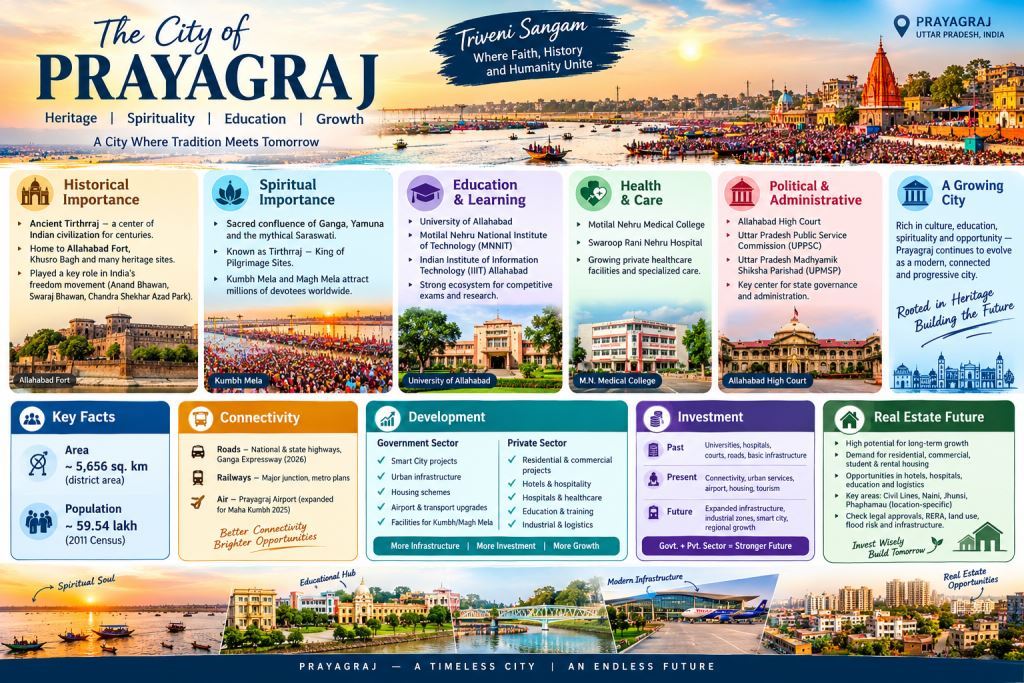
Prayagraj, formerly known as Allahabad, is one of Uttar Pradesh’s most significant cities. Situated at the sacred confluence of the Ganga and Yamuna rivers, the city combines ancient heritage, spiritual importance, educational excellence, political history and modern urban development.
A City of Historical and Spiritual Significance
Prayagraj has been an important centre of Indian civilization for centuries. Known traditionally as Tirthraj, or the King of Pilgrimage Sites, it is home to the Triveni Sangam, where millions of devotees gather for religious observances. The Kumbh Mela and Magh Mela have established the city as one of the world's most prominent pilgrimage destinations.
The city also played a major role in India's freedom movement. Anand Bhawan, Swaraj Bhawan and Chandra Shekhar Azad Park preserve important memories of the independence struggle. Its historical landmarks, including Allahabad Fort and Khusro Bagh, reflect its rich architectural and cultural heritage.
Education, Healthcare, Politics and Administration
Prayagraj is widely recognized as an educational centre, with institutions such as the University of Allahabad, Motilal Nehru National Institute of Technology and Indian Institute of Information Technology Allahabad. Its competitive-examination ecosystem attracts students aspiring to government and professional careers.
The city is also an important regional healthcare centre, supported by Motilal Nehru Medical College, Swaroop Rani Nehru Hospital and private medical facilities. Its political and administrative importance is equally substantial. The Allahabad High Court,Uttar Pradesh Public Service Commission and Uttar Pradesh Madhyamik Shiksha Parishad are among the institutions that contribute to its influence across the state.
Population, Connectivity and Urban Development
Prayagraj district had a population of approximately 59.54 lakh according to the 2011 Census. Its large rural and urban hinterland supports trade, agriculture, education, healthcare and public services.
Roads, railways and air connectivity link Prayagraj with major cities across India. The Ganga Expressway, inaugurated in April 2026, strengthens regional connectivity, while airport improvements undertaken for the 2025 Maha Kumbh enhanced passenger-handling capacity.
Government-led initiatives, including Smart City projects, urban infrastructure improvements, housing schemes and facilities developed for major religious gatherings, are helping shape the city's development. Their lasting impact will depend on effective implementation, maintenance and the creation of sustainable economic activity.
Government and Private-Sector Investment
Public investment has historically supported Prayagraj's universities, hospitals, courts, roads and administrative infrastructure. More recent investment has focused on regional connectivity, urban services, airport facilities and housing.
Private-sector opportunities include residential developments, apartments, plotted townships, commercial shops, offices, hotels, hospitals, educational facilities and industrial or logistics properties. Religious tourism creates additional demand for hospitality, transport and visitor-related services, although seasonal demand must be distinguished from year-round business activity. The long-term growth of private investment will depend on infrastructure quality, employment generation, affordable housing demand and a transparent regulatory environment.
The Future of Real Estate in Prayagraj
Prayagraj offers potential for long-term, location-selective real-estate investment. Established commercial districts may attract investors seeking rental income, while properly approved residential developments may appeal to families and long-term buyers.
Demand for student accommodation, rental housing, medical-related accommodation and commercial premises is supported by the city's educational, judicial and healthcare institutions. Hotels and guesthouses may benefit from religious tourism, while selected industrial and logistics locations could gain from improved regional connectivity.
Areas such as Civil Lines, Naini, Jhunsi and Phaphamau warrant different types of location-specific assessment rather than being treated as a single investment market. Buyers must examine actual road access, land-use permissions, infrastructure availability, local prices and rental demand.
Investors should also verify property titles, development approvals, applicable RERA registration, flood risks and the status of proposed infrastructure. Agricultural land should never be assumed to become residential or commercial land automatically.
Conclusion
Prayagraj is much more than a religious destination. It is a historic city, an educational and healthcare centre, a major judicial and administrative hub, and an increasingly connected urban market.
Its future development will depend on how effectively government infrastructure, private investment, employment generation and environmental conservation work together.
For real-estate investors, Prayagraj deserves attention as a potential long-term growth market—but success will depend on choosing the right location, verifying legal approvals and investing according to genuine demand rather than speculation.



Leave a Comment