
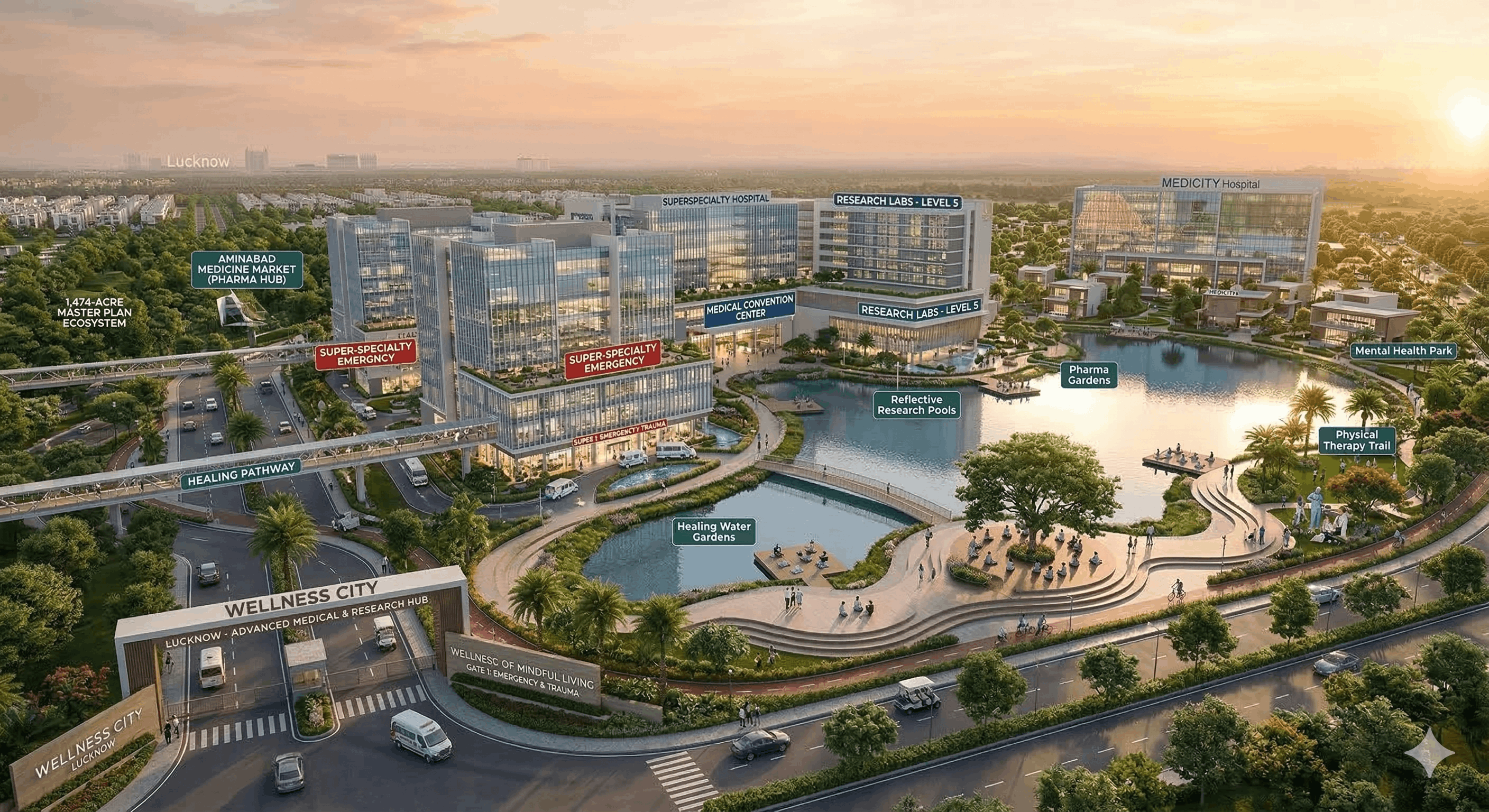
In 2026, Lucknow is shedding its image as a purely heritage-driven city to become a pioneer in health-centric urban planning. The Wellness City project, spearheaded by the Lucknow Development Authority (LDA), is the centerpiece of the Lucknow Master Plan 2031, aiming to redefine urban living through the lens of preventive healthcare and sustainability.
Project Overview: The Blueprint of Health
Located strategically on Sultanpur Road (near the Kisan Path and Shaheed Path intersection), Wellness City spans approximately 1,474 acres. Unlike traditional townships focused on high-density housing, Wellness City is designed as a "living lung" for the capital.
Total Area & Layout (Wellness City)
The total area of Wellness City is approximately 1,474 acres. It is designed with a low-density, high-quality-of-life framework.
- Total Plots: 2,935 residential plots (ranging from 1,200 to 4,800 sq. ft.).
- Green Reserve: 17% of the land (approx. 204 acres) is strictly reserved for green belts and parks.
- Healthcare Zone: 150 acres dedicated to super-specialty hospitals and medical colleges.
- The "Saptrishi" Design: The city is divided into 7 Sectors, each named after the Vedic Saptrishis (Sages), symbolizing a return to holistic roots.
Key Infrastructure Components:
- Medical Hubs: Includes super-specialty hospitals, a medical college, and the relocation of the famous Aminabad medicine market into a modern, organized trade zone.
- Holistic Wellness: Dedicated zones for Meditation centers, Yoga institutes, and a Vipassana center.
- Green Infrastructure: 17% of the total land area (approx. 204 acres) is strictly reserved for parks and oxygen belts.
List of Villages Under Wellness City
The land for Wellness City has been consolidated primarily from the following villages along the Sultanpur Road corridor. Some villages (like Bakkas) are shared with the IT City project due to their massive size and central location.
| Village Name | Key Role in Wellness City |
|---|---|
| Bakkas | The primary entry point; houses the proposed relocated Aminabad Medicine Market. |
| Mastemau | Recently added (~127 acres expansion) to accommodate premium wellness resorts. |
| Dularmau | Focus area for super-specialty hospital clusters and medical colleges. |
| Noorpur Behta | Dedicated primarily to residential plotting and the Vipassana meditation center. |
| Chaurahia | Reserved for green buffers and social infrastructure (schools/community centers). |
| Chaurasi | Location for the proposed "Yoga Village" and naturopathy institutes. |
Real Estate Analytics & Market Trends (2026)
Wellness City has shifted the investment gravity of Lucknow from the saturated Gomti Nagar to the Sultanpur Road corridor.
| Metric | Details (Forecast 2026-27) |
|---|---|
| Primary Asset Class | Plots & Luxury Health-Townships |
| Current Price Range | ₹4,800 – ₹6,200 per sq. ft. |
| Annual Projected Growth | 20–25% YoY |
| Housing Volume | 10,000+ Group Housing units planned |
| Demand Driver | Medical Tourism & High-Income Professionals |
Analytic Note: Properties within Wellness City are reportedly selling 35–40% faster than standard residential projects in Lucknow. This "Wellness Premium" is driven by buyer demand for gated security, air filtration zones, and reflexology paths.
Comparative Growth Analysis
To understand its impact, we can compare the projected land value appreciation of the Wellness City corridor against other major Lucknow hubs.
Projected ROI Comparison (2024–2027)
(Estimated based on LDA 2026 market disclosures)
- Sultanpur Road (Wellness City): 📈 85% Appreciation
- Kisan Path (IT/Logistics): 📈 70% Appreciation
- Gomti Nagar Extension: 📈 45% Appreciation
- Raebareli Road (SGPGI Cluster): 📈 50% Appreciation
4. Visualizing the Shift: Sustainability vs. Density
Lucknow’s urban planning is pivoting toward "Transit-Oriented Development" (TOD). The chart below highlights how Wellness City compares to the national metro average in terms of livability.
| Feature | Lucknow (Wellness City) | Delhi-NCR (Avg) |
|---|---|---|
| Green Cover % | 40% | 20% |
| Avg. Commute | 30 Mins | 60 Mins |
| Air Quality Index (Avg) | 90 (Target) | 180+ |
5. Economic & Social Impact
The development is expected to attract over ₹10,000 crore in private investment. Beyond real estate, the project addresses three critical urban challenges:
- De-congestion: Shifting the medicine wholesale market reduces traffic in Old Lucknow.
- Job Creation: The medical and hospitality sectors are projected to create 15,000+ direct jobs.
- Medical Tourism: By integrating world-class hospitals with "recovery resorts," Lucknow is positioning itself as a destination for patients from across North India and Nepal.
Conclusion
Wellness City is not just a housing project; it is a strategic hedge against the "urban decay" seen in other Indian metros. For investors, the 20-25% annual growth rate makes it a top-tier asset, while for residents, it offers a rare combination of modern healthcare and ecological balance.

Leave a Comment