
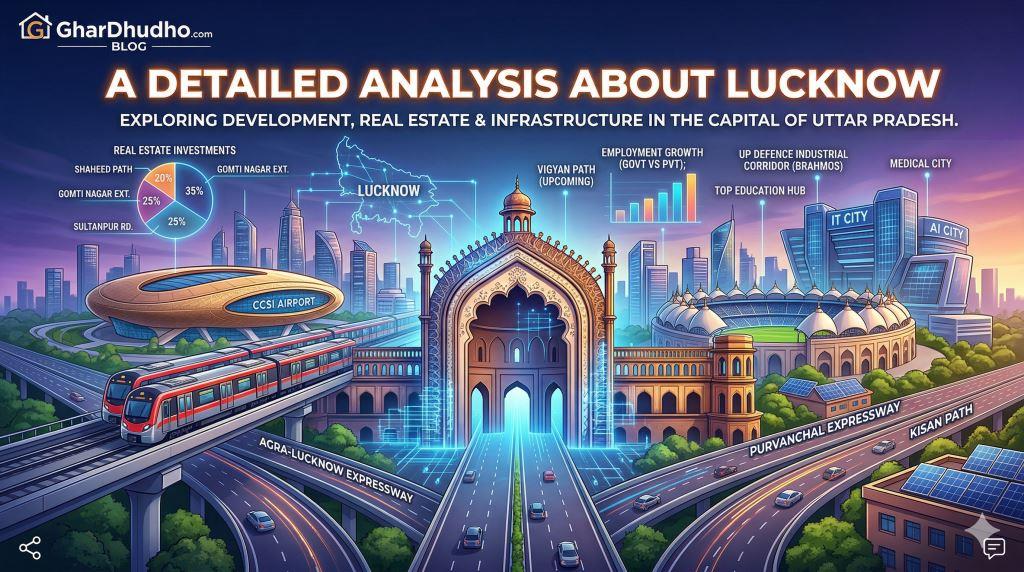
Lucknow, the "City of Nawabs" and the capital of Uttar Pradesh, has transformed from a historical center of culture and arts into a burgeoning 21st-century economic engine. As the administrative heart of India’s most populous state, Lucknow's significance is no longer just political; it is now a critical hub for defense, technology, and real estate.
The Strategic Importance of Lucknow
As the capital, Lucknow serves as the nerve center for a state that contributes significantly to India’s GDP. With the Uttar Pradesh government aiming for a $1 trillion economy, Lucknow is the primary execution ground for this vision.
Administrative & Political Hub
Being the seat of the Government of Uttar Pradesh, Lucknow houses the Vidhan Sabha, High Court (Lucknow Bench), and headquarters of all major state departments. This administrative concentration ensures:
- Infrastructure Priority: Lucknow receives first-mover advantage for state-wide infrastructure projects like Expressways and Metro expansions.
- Policy Proximity: Businesses benefit from direct proximity to policy-makers and regulatory bodies.
Infrastructure & Connectivity: The Growth Catalysts
Aviation: Chaudhary Charan Singh International Airport (CCSIA)
Under the management of Adani Airports, CCSIA is undergoing a massive transformation.
- Investment: Close to ₹10,000 crore allocated for expansion.
- Terminal 3 (T3): Set to double passenger capacity from 8 million to 14 million by 2026–27.
- Global Reach: Runway extension from 2,744m to 3,500m will allow wide-body aircraft (like the Boeing 777 and Airbus A350) to fly non-stop to the US and Europe.
National Highways, Expressways & Greenfield Corridors
Lucknow is now the "Expressway Capital" of India, with new greenfield projects bypassing urban congestion.
- Lucknow–Kanpur Expressway (NE-6): This 63 km "Awadh Expressway" is slated for full inauguration by early April 2026. This corridor reduces travel time to 30–35 minutes. It features 45 km of entirely advanced AI-guided greenfield construction and 18 km of elevated roadway.
- Agra-Lucknow & Purvanchal Expressway: The Agra-Lucknow Expressway (302 km) and Purvanchal Expressway (341 km) are now being directly integrated via the newly tendered Lucknow Link Expressway, a 51 km greenfield corridor that bypasses city traffic to connect the two major arteries.
- Amar Shahid Path : The Amar Shaheed Path is a critical 23.5 km elevated outer bypass that serves as the lifeline of modern Lucknow, seamlessly connecting Kanpur Road (NH-25) to Ayodhya Road (NH-28). As of 2026, it has transformed into the city's primary "Growth Corridor," hosting iconic landmarks like the Lulu Mall, Phoenix Palassio, Ekana Stadium, and Medanta Hospital. The stretch is currently seeing massive infrastructure upgrades, including the integration of the Lucknow-Kanpur Expressway at one end and a new Green Corridor link that will slash travel time to the city center to just 15 minutes. Its strategic importance has made it the most sought-after real estate hub, with property values appreciating significantly due to its role as the central artery for all major state and national highway transit.
- Kisan Path (Outer Ring Road): This 104 km loop is the new "Inner Circle" for development. It connects all five major highways (Lucknow-Ayodhya, Sultanpur, Rae Bareli, Kanpur, and Hardoi) without entering the city.
- National Highways & Kisan Path: Lucknow is the junction for several major NH routes, including NH-27 (East-West Corridor), NH-30, and NH-731; these are now interconnected by the 104 km Outer Ring Road (Kisan Path/NH-230), which has been fully operationalized to divert over 1.6 lakh vehicles away from the city center daily.
- Ganga Expressway Connection: While the main expressway is West-East, the link roads to Lucknow are turning the city into a logistics transit point for goods moving from Haridwar to Prayagraj.
- Vigyan Path : Proposed as the "outermost ring road" for the State Capital Region (SCR), Vigyan Path is an ambitious 250 km, six-lane greenfield expressway designed to encircle Lucknow and seamlessly connect it with five neighboring districts: Hardoi, Sitapur, Barabanki, Rae Bareli, and Unnao. Named in honor of former Prime Minister Atal Bihari Vajpayee’s "Jai Vigyan" slogan, the project aims to reduce travel time between these districts and the capital to just 60–75 minutes while serving as a massive industrial backbone with 20 proposed development nodes for IT parks, medical hubs, and educational institutions. This corridor will act as the third major layer of Lucknow’s radial infrastructure—following Shaheed Path and Kisan Path—to decongest the city center and drive Uttar Pradesh's goal of becoming a $1 trillion economy by 2027.
Lucknow has evolved into a "Macro-City," where infrastructure is no longer just about roads but about creating specialized ecosystems for technology, defense, and high-speed transit. As of 2026, the city is undergoing a structural shift toward the South and East (Sultanpur Road and Kanpur Road axes).
Industrialization & Defense
The Lucknow Defence Corridor Node
As one of the six nodes in the UP Defence Industrial Corridor, Lucknow is the high-tech manufacturing center. A state-of-the-art facility is being set up in Lucknow to manufacture BrahMos-NG missiles, attracting an ecosystem of MSMEs.
- BrahMos-NG Facility: The centerpiece of this node, where next-generation supersonic cruise missiles are being integrated.
- MSME Ecosystem: Over 30 private firms have been allotted land to set up ancillary units for aerospace and electronics, creating a specialized industrial zone on the city's outskirts.
IT City: The "Walk-to-Work" Ecosystem
The UP IT City on Sultanpur Road (spanning 2,660 acres) has moved from a concept to a massive residential and commercial reality. It has already established Lucknow as a Tier-2 IT powerhouse.
- Residential Launch (Jan 2026): The Lucknow Development Authority (LDA) has launched approximately 10,000 residential plots within the IT City to support a projected population of 100,000.
- Zoning:
- Industrial (400 Acres): Dedicated to IT/ITES giants (beyond HCL).
- Green Belt & Leisure: Includes a 200-acre Golf City and a 15-acre central water body.
- Economic Impact: It is positioning Lucknow as a "Tier-2+ " tech hub, rivaling the early days of Noida by offering integrated living where professionals live within walking distance of their offices.
India’s First "AI City" (Nadarganj)
Lucknow is pioneering the AI revolution in India with a dedicated ₹10,732 crore investment for an AI City near the Airport (Nadarganj). The government has earmarked 20+ acres for India’s first "AI City" in Lucknow to foster startups and tech research.
- Infrastructure: The project includes 10,000 Graphics Processing Units (GPUs) and a multi-modal language model center.
- Design: A 70-acre campus with a 60:40 ratio—60% for core tech (AI labs, data centers) and 40% for supporting infrastructure (luxury housing, schools).
- Strategic Goal: To house global AI giants and startups, moving away from simple software services to deep-tech research.
Specialized Hubs: Education, Medical, and Logistics
| Hub Type | Key Institutions/Projects | Impact/Significance |
| Medical Hub | SGPGI, KGMU, RMLIMS, and new Medical Device Park. | Lucknow is now a destination for "Medical Tourism" for North India and Nepal. |
| Education Hub | IIM Lucknow, AKTU, National Law University, and private varsities like Amity/BBD. | High concentration of student population creates demand for PGs and rental housing. |
| Logistics Hub | UPSIDA approved warehousing projects (approx. ₹800 cr). | Proximity to Purvanchal and Agra-Lucknow Expressways makes it a distribution center. |
Employment Landscape: Government vs. Private
The employment scenario in Lucknow is shifting from traditional "Sarkari Naukri" (Government Jobs) to a diversified private sector.
- Current Scenario: The government remains a major employer through the Secretariat, Railways, and Public Sector Banks. However, the private sector (Retail, IT, Healthcare) now accounts for nearly 45-50% of formal urban employment.
- Future Trends: Manufacturing: The BrahMos unit and Ashok Leyland’s EV plant are expected to create thousands of technical jobs.
- IT/ITES: With the AI City and HCL expansion, Lucknow is becoming a hub for "Reverse Migration" for techies from Noida and Bengaluru.
- Unemployment Rate: Uttar Pradesh’s unemployment rate has significantly declined to approximately 2.4% as of 2024-25, with Lucknow showing higher absorption rates in services.
Comparative Infrastructure Analysis
| Feature | IT City (Sultanpur Rd) | AI City (Nadarganj) | Defence Corridor |
| Primary Focus | Software & Services | AI, ML & Deep Tech | Aerospace & Heavy Engineering |
| Key Anchor | HCL Tech, LDA Plots | Government AI Innovation Center | BrahMos Aerospace |
| Investment Scale | High (Real Estate driven) | Very High (Tech Infrastructure) | Massive (Strategic/Industrial) |
| Target Workforce | Software Engineers, BPO | AI Researchers, Data Scientists | Defense Techs, Mechanical Engineers |
Emerging Infrastructure Nodes (2026-2030)
Beyond the headline projects, several "Satellite Cities" are being developed under the Master Plan 2031:
- Wellness City: Planned on Sultanpur Road focusing on healthcare and holistic living.
- Varun Vihar: A new township strategically placed next to the Agra-Lucknow Expressway to capture the western migration.
- Medical City (Chak Ganjaria): Consolidating super-specialty hospitals like Medanta and SGPGI extensions into a single healthcare corridor.
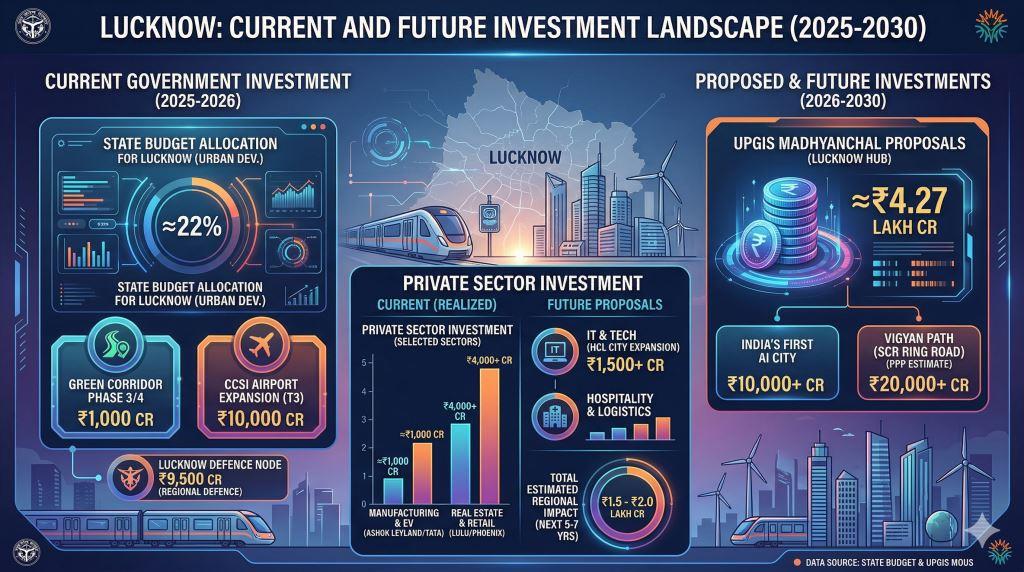
Lucknow’s investment landscape is currently defined by a massive surge in both government-led infrastructure and private sector capital. As the focal point of Uttar Pradesh's $1 trillion economy goal, the city has secured significant commitments through the UP Global Investors Summit (GIS) and state budgetary allocations for 2025-26.
1. Current Government Investment (2025–2026)
The public sector is currently pouring thousands of crores into "Hard Infrastructure" to facilitate private growth.
- Green Corridor Project: The UP government recently allocated ₹1,000 crore specifically to fast-track Phases 3 and 4 of the Lucknow Green Corridor. This project is aimed at decongesting the city by mid-2026.
- Aviation Expansion: Approximately ₹10,000 crore is being deployed for the expansion of Chaudhary Charan Singh International Airport (managed by Adani), including the newly operational Terminal 3.
- State Budget 2025-26: The total state budget of ₹8,08,736 crore (a 9.8% increase) prioritizes Lucknow for major urban development and infrastructure, which accounts for roughly 22% of the total outlay.
- Defense & Aerospace: Initial government spending on the Lucknow Defense Node (including the BrahMos facility) is part of a larger ₹9,500 crore regional defense investment plan.
2. Private Sector Investment (Current & Ongoing)
Private companies have transitioned from "MoU stage" to "Ground Breaking" in several sectors:
- Manufacturing & EV: * Ashok Leyland: Setting up an EV bus plant with an investment of roughly ₹1,000 crore.
- Tata Motors: Continuous investment in their Lucknow facility for EV and hydrogen bus production.
- Real Estate & Retail: * Lulu Group & Phoenix Group: Combined investments in retail and mixed-use developments (Lulu Mall and Palassio) exceed ₹4,000 crore.
- Hospitality: Major groups like IHCL (Taj/Vivanta) and Marriott are expanding with new properties near Shaheed Path and the Airport.
- IT & Technology:HCL IT City remains a primary private investment anchor, having invested over ₹1,500 crore in its 100-acre campus.
3. Proposed & Future Investments (2026–2030)
The scale of future investment is projected to be even larger, driven by the MoUs signed during the Global Investors Summit.
- AI City Project: The proposed India's first AI City in Nadarganj has a total projected ecosystem value of over ₹10,000 crore, with the government currently inviting global bids for the master developer.
- Madhyanchal Region (Lucknow Hub): At UPGIS 2023, the Madhyanchal region (centered around Lucknow) received investment proposals worth approximately ₹4.27 lakh crore, making up 13% of the state's total ₹33.5 lakh crore proposals.
- Vigyan Path (SCR Ring Road): This proposed 250 km outer-outer ring road is expected to attract an estimated ₹20,000–₹25,000 crore in public-private partnership (PPP) investments for the surrounding industrial and residential nodes.
- Logistics & Warehousing: Private players like Welspun One and TCI have proposed warehouses along the Lucknow-Kanpur Expressway, with cumulative investments expected to cross ₹5,000 crore by 2030.
Investment Summary Table
| Category | Current/Realized Investment | Proposed/Future Investment |
| Infrastructure | ₹15,000+ Cr (Airport, Metro, Roads) | ₹50,000+ Cr (SCR, Vigyan Path, Metro Ph-2) |
| Tech & AI | ₹2,500 Cr (HCL, Startup Nodes) | ₹10,000+ Cr (Nadarganj AI City) |
| Manufacturing | ₹3,000 Cr (Ashok Leyland, BrahMos) | ₹15,000+ Cr (Defence Ancillary units) |
| Real Estate | ₹8,000+ Cr (Integrated Townships) | ₹25,000+ Cr (New LDA Schemes & Pvt Towers) |
Total realized and proposed investment specifically impacting the Lucknow district and its immediate satellite towns is estimated to be in the range of ₹1.5 lakh crore to ₹2 lakh crore over the next 5–7 years, making it one of the most heavily invested-in Tier-2 cities in Asia.
Hotspots & ROI Analysis
| Location | Current Price Range (sq. ft.) | Estimated Annual Appreciation | Why Invest? |
| Shaheed Path | ₹6,500 – ₹9,000 | 12% - 15% | High demand due to connectivity and Lulu Mall. |
| Sultanpur Road | ₹4,000 – ₹6,000 | 18% - 20% | Highest growth potential due to proximity to HCL and Defence Corridor. |
| Gomti Nagar Ext. | ₹7,000 – ₹11,000 | 10% | Established luxury; high rental yield (3-4%). |
ROI Outlook: Investors can expect a CAGR of 12-15% over the next 5 years. For plotted developments on the outskirts (Kisan Path), the ROI has historically touched 25% year-on-year.
Real Estate: The ROI Goldmine
Lucknow’s real estate is currently in a "Sweet Spot"—it has moved past the stagnant phase but hasn't yet hit the peak prices of Delhi-NCR.
Market Drivers
- Public Players: Lucknow Development Authority (LDA) and UP Housing Board (Awas Vikas) are developing massive townships like Pradhan Mantri Awas Yojana and new sectors along Sultanpur Road.
- Private Players: Giants like DLF, Rishita, Shalimar, and Omaxe are shifting focus to ultra-luxury apartments and integrated townships.
Why Invest in Lucknow?
- Political Stability: Consistent focus on "Ease of Doing Business."
- Connectivity: Intersection of multiple Expressways (Agra-Lucknow, Purvanchal, and the upcoming Ganga Expressway).
- Infrastructure-led Growth: The expansion of the Metro and International Airport directly correlates with property value surges.
- Quality of Life: Lower cost of living compared to NCR/Mumbai while offering similar amenities (Malls, International Schools, Five-star Hotels).
Future Outlook
The "Lucknow-Kanpur State Capital Region (SCR)" is becoming a reality. The Greenfield Expressway and AI City are expected to triple the per capita income of Lucknow residents by 2030, as the city transitions from a consumer of services to a producer of high-value technology and defense hardware.
Lucknow is no longer just a city of heritage; it is a city of high-speed growth. With the government pouring billions into defense and aviation, and private players mirroring that confidence in real estate and IT, Lucknow stands as one of the most promising investment destinations in India for 2026 and beyond.


Leave a Comment