
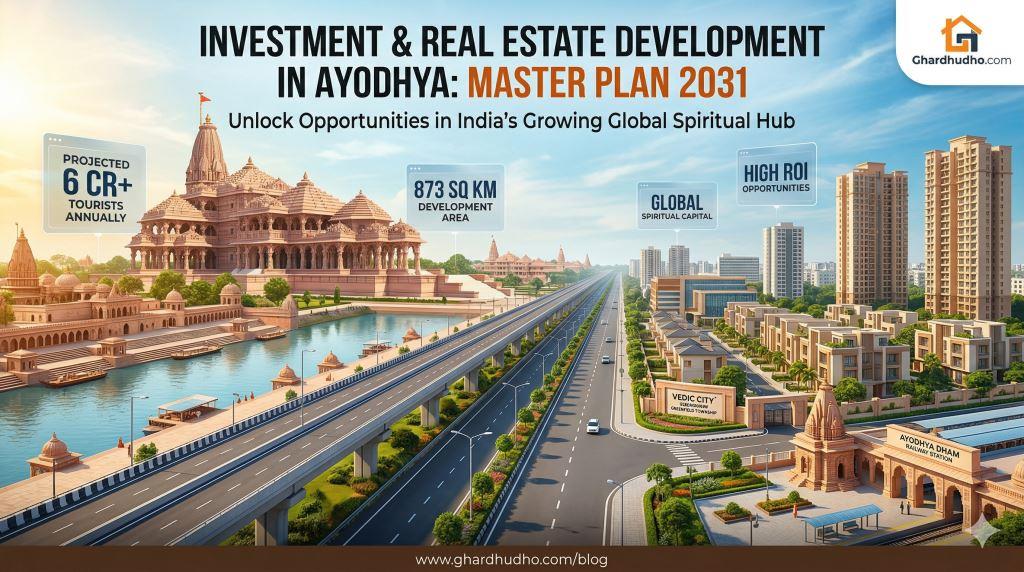
The Ayodhya Development Authority (ADA), formerly known as the Ayodhya-Faizabad Development Authority, is the primary government agency responsible for the planned, sustainable, and modern transformation of Ayodhya. Following the 2024 Ram Mandir consecration, the ADA's role has shifted from a local administrative body to the lead architect of a global spiritual and smart city.
Ayodhya, the spiritual heart of Uttar Pradesh, is currently undergoing one of the most significant urban transformations in modern Indian history. Since the consecration of the Shri Ram Janmabhoomi Mandir in January 2024, the city has evolved from a quiet pilgrimage town into a global economic and tourism powerhouse.
Ayodhya is currently at the center of a massive economic and urban transformation. Driven by the Ayodhya Master Plan 2031, the city is evolving from a pilgrimage site into a global spiritual and commercial hub through a blend of heavy public spending and aggressive private sector entry. Ayodhya is currently witnessing an unprecedented real estate boom, fueled by the government’s Rs. 85,000 crore infrastructure push and the massive influx of spiritual tourists. The market has shifted from localized land trading to structured, large-scale integrated townships developed by both government bodies and premium private players.
Strategic Planning: The Ayodhya Master Plan 2031
The ADA is the custodian of the Ayodhya Master Plan 2031, which serves as the blueprint for the city's future growth.
- Expansion of City Limits: Under Phase 2 of the plan (initiated in 2025), the ADA has expanded its planning area to 873 sq. km, incorporating 343 villages from the neighboring Basti and Gonda districts.
- Population Readiness: The plan is designed to support an estimated population of 14 lakh (1.4 million) by 2031, focusing on creating a "Global Spiritual Capital."
- Zoning & Regulation: ADA regulates land use, ensuring that residential, commercial, and industrial zones are strictly demarcated to prevent haphazard growth.
Significance of the Ram Mandir
The Ram Mandir is the primary catalyst for Ayodhya’s rebirth. Beyond its religious and cultural sanctity, it has become an "Economic Engine" for the region.
- Footfall Explosion: Before 2024, Ayodhya saw approximately 1.7 lakh visitors annually. In the first six months post-consecration alone, the city recorded over 11 crore (110 million) devotees.
- Economic Turnaround: A study by IIM Lucknow (2026) highlights that local traders' daily income has surged from ₹400–500 to over ₹2,500.
- Revenue Contribution: Ayodhya is projected to contribute nearly 25% of Uttar Pradesh's tourism-led GSDP by 2028, with an estimated annual tourism economy of ₹18,000 crore.
Major Infrastructure & Public Projects
The ADA oversees and executes critical projects that improve the city’s functionality and aesthetics.
- Vedic Townships: The authority is leading the development of the Navya Ayodhya (Green Field Township), a 1407-acre smart city project that includes state-of-the-art residential sectors and guest houses for international visitors.
- Multi-Level Car Parking (MLCP): To manage the massive influx of tourists, the ADA has constructed several high-capacity parking facilities, such as the Tedhi Bazar and Amaniganj MLCPs, which also house commercial shops.
- Beautification & Rejuvenation: The ADA is actively working on the restoration of historical sites like Surya Kund and the ecological rejuvenation of 8 local lakes (ponds) to boost eco-tourism.
Sustainability & Smart City Initiatives
ADA is the key driver in making Ayodhya a "Model Solar City" and an eco-friendly destination.
- EV Infrastructure: In collaboration with Tata Power, the ADA is installing electric vehicle (EV) charging stations at all major public parking locations to promote green mobility.
- Solar Power: The authority is implementing solar-powered street lighting and ensuring that new construction projects adhere to green building norms.
- Facade Control: ADA has implemented strict Facade Control Guidelines to ensure that the architecture of buildings along main paths (like Ram Path) maintains a uniform, culturally resonant aesthetic.
Facilitating Private & Public Partnerships (PPP)
The ADA acts as a bridge for private investors and other government bodies.
- Regulatory Approvals: It handles map approvals, mutation, and freehold conversions for developers like HoABL and Abhinandan Lodha, facilitating the "7-star" luxury projects entering the city.
- Housing Schemes: The authority periodically launches affordable housing schemes like Vashisht Kunj Phase-1 to ensure that development remains inclusive for local residents.
ADA Key Achievements (2024–2026)
| Project Category | Key Accomplishment |
| Connectivity | Completed Ram Path and Dharma Path widening and landscaping. |
| Sustainability | Partnered for 40 MW solar plant and extensive EV network. |
| Tourism | Developed Guptar Ghat Park and surrounding tourist kiosks. |
| Technology | Launched E-Services for online building map approvals and property registration. |
Infrastructure & Urban Development
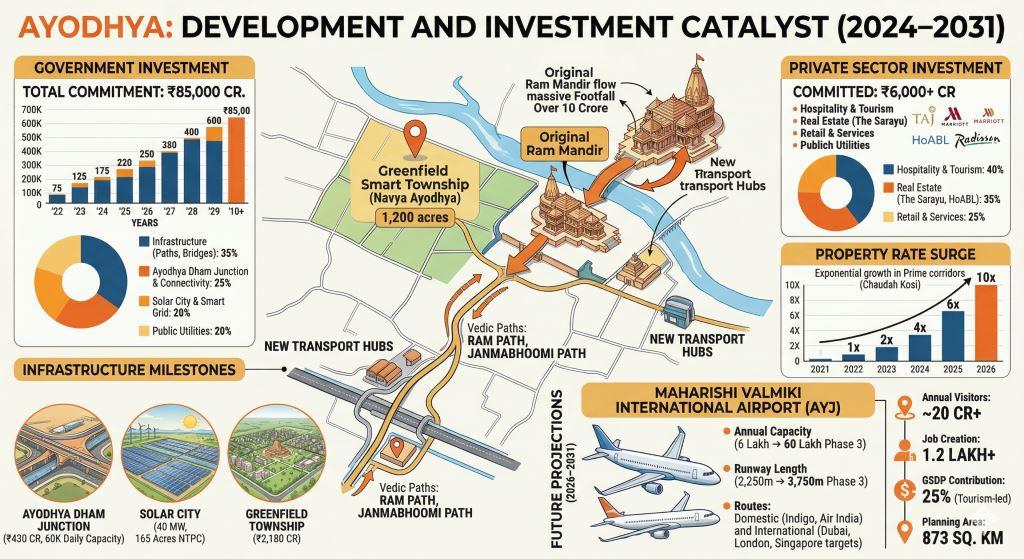
The government has committed over ₹85,000 crore for the "Ayodhya Master Plan 2031," aiming to make it a world-class Smart City.
Key Infrastructure Pillars:
- Ram Path & Connectivity: The 13-km "Ram Path" serves as the city’s main artery, complemented by the Bhakti Path and Janmabhoomi Path.
- Ayodhya Dham Junction: The railway station has been redeveloped with a ₹430 crore investment, featuring airport-like amenities and a capacity to handle 60,000 passengers daily.
- Green & Solar City: Ayodhya is being developed as UP's first "Solar City," with solar-powered streetlights, luxury electric catamarans on the Saryu River, and EV-only zones.
Maharishi Valmiki International Airport (AYJ)
The airport is a cornerstone of Ayodhya’s global accessibility.
- Phase 1 (Complete): Capacity of 6 lakh passengers annually with a 2,250 meter runway.
- Phase 2 & 3 (Underway): Investment of ₹1,625 crore to expand the terminal to 50,000 sq. m. and extend the runway to 3,750 meter, making it capable of handling large international aircraft like the Airbus A380.
Investment: Government vs. Private Sector
Ayodhya has become a "hotspot" for both public funding and private equity.
| Sector | Key Investors / Projects | Impact/Figures |
| Hospitality | Taj, Marriott, Wyndham, Radisson, Eco Hotels | 150+ new hotels; Room demand rising from 4k to 12k+ |
| Real Estate | House of Abhinandan Lodha (HoABL), UP Awas Vikas | Land prices increased 5x to 10x in prime corridors |
| Public Works | UP Govt / Central Govt | ₹250 crore special budget for 2026 tourism infra |
| MSMEs | Local Artisans & GI Tagged products | 6,000+ new MSMEs established/revived |
Government Investment: Building the Foundation
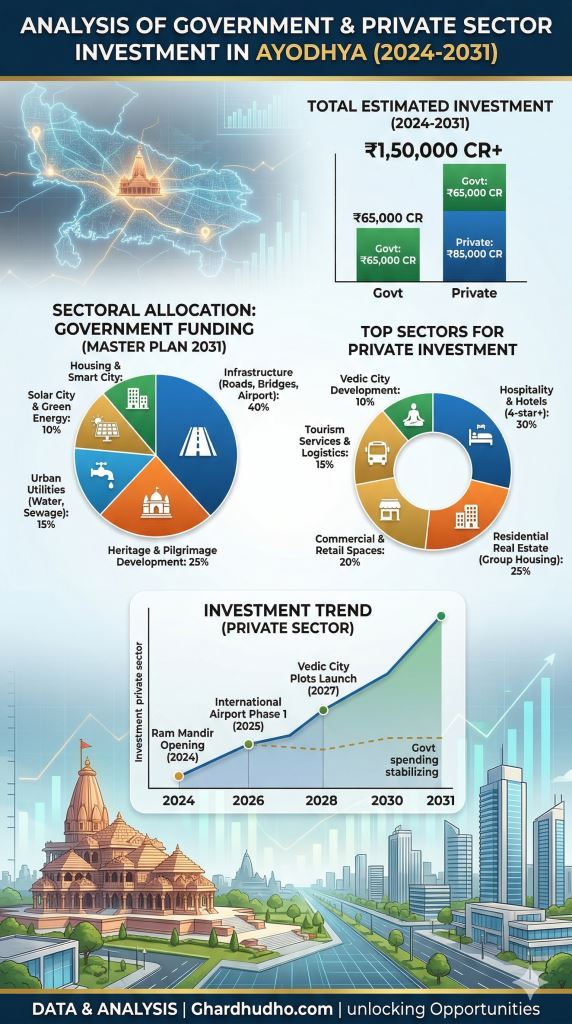
The government has committed an estimated Rs. 85,000 crore for the overall redevelopment of Ayodhya over the next decade. The government is leading the transformation with "smart" urban planning to handle the projected population of 14 lakh by 2031.
Key Infrastructure Projects:
- Infrastructure Corridor: Over Rs. 30,500 crore was allocated for 178 immediate priority projects. This includes the development of the four "Vedic" paths: Ram Path, Dharma Path, Bhakti Path, and Janmabhoomi Path.
- Ayodhya Dham Junction: Redeveloped at a cost of Rs. 240–430 crore, featuring a three-story modern terminal with a capacity for 60,000 daily passengers.
- Solar City Initiative: Ayodhya has been declared a Model Solar City. NTPC Green Energy has commissioned a 40 MW solar plant (on 165 acres), and the city features the world’s longest solar-powered street lighting stretch.
- Navya Ayodhya (Green Field Township): This is the flagship project by the U.P. Awas Evam Vikas Parishad (UPAVP). A new 1200-acre smart township is being developed at an investment of approximately Rs.2180 crore to accommodate the rising resident and tourist population.
- Scale: Spans over 1,407 acres near the NH-27 bypass.
- Features: Designed as a sustainable Vedic city with underground utilities, a "Green-Blue Corridor" linked to the Saryu River, and dedicated sectors for State Bhavans, international guest houses, and high-end residential plots.
- Status: Plot allotments for sectors like 8A, 8C, and 9A began in late 2025, with infrastructure work aiming for completion by 2028-2030.
- Vashisht Kunj Yojna: Managed by the Ayodhya Development Authority (ADA), this project focuses on organized residential clusters to accommodate the growing middle-class and professional population moving to the city.
- Maharishi Valmiki International Airport (AYJ) : The airport is the primary gateway for international and domestic investors.
- Phase 1 Investment: Rs.1450 crore for a terminal handling 10 lakh (1 million) passengers annually.
- 2025-26 Expansion: The state recently proposed additional funds to expand the runway to 3750 meters, allowing for large international aircraft (Boeing 777/Airbus A380).
- Performance: In its first full year (2024-25), the airport handled over 1.1 million passengers, exceeding its initial design capacity.
Private Sector Investment: The Commercial Boom
Private players have committed over Rs. 6000 crore in the initial wave, primarily across hospitality, real estate, and retail. Private developers are introducing "7-star" luxury and branded land concepts previously unseen in this region.
Hospitality & Tourism:
Major global and national hotel chains have signed deals to meet the demand for luxury and mid-scale stays:
- IHCL (Taj/Vivanta/Ginger): Signed multiple properties, including a flagship Taj Hotel expected by 2026.
- Marriott, Radisson, & Wyndham: Actively developing over 150 new hotel projects to increase the room count from 4000 to over 12000 by 2028.
- Leela Group: Partnered for an ambitious Rs. 450 crore luxury project.
Real Estate & Branded Land:
- The Sarayu (House of Abhinandan Lodha - HoABL): * Investment: A Rs. 1200 crore integrated township "The Sarayu," a 75-acre luxury branded land development.
- Highlights: Features Ayodhya’s first 7-star vegetarian hotel (in collaboration with The Leela Group).
- Exclusivity: Famous as the project where Amitabh Bachchan became the first citizen. It offers premium plots, villas (Sarayu Villas), and luxury "Sky Palaces."
- Geo Spar Developers: Focusing on eco-conscious living, they have launched multiple RERA-registered townships like Mau Shivala and Bharat Kund, offering more accessible price points starting from Rs. 14.5 Lac for plots.
- Land Value Surge: Property rates in prime areas like Chaudah Kosi Parikrama have seen a 5x to 10x increase, moving from Rs. 1500/sq.ft to over Rs. 10,000/sq.ft in just three years.
Key Investment Zones & Rates (2026 Estimates)
| Location | Best For | Estimated Rates (per sq. ft.) |
| Temple Corridor (0-5 km) | Commercial, Hotels, Luxury Stays | Rs. 10000 – Rs. 20000 |
| Lucknow-Gorakhpur Highway | Integrated Townships, Logistics | Rs. 2500 – Rs. 6000 |
| Airport Road / Ring Road | Premium Residential, Corporate Guest Houses | Rs. 4000 – Rs. 8000 |
| Peripheral Areas (10+ km) | Long-term Land Investment | Rs. 1000 – Rs. 2500 |
Comparative Growth Metrics (Pre-Mandir 2023 vs. Post-Mandir 2026)
| Category | Status in 2023 | Status/Projection 2026 |
| Annual Visitor Footfall | 2 Crore | 15-20 Crore |
| Daily Visitor Spend | Low (Day-trips) | High (Multi-day stays) |
| Airport Capacity | Under Construction | 60 Lakh (Phase 2/3 Target) |
| Solar Power Capacity | 0 MW | 40 MW (Active) |
| Direct/Indirect Jobs | Minimal | 25,000 - 30,000 created |
| Property Rates | Rs. 1500/sq.ft | Rs. 5500 - Rs.15000/sq.ft |
| Commercial Units | 200 Restaurants | 2000+ Restaurants |
| Govt. Budget Allocation | Rs. 2000 Cr/yr | Rs. 85000 Cr (10-yr plan) |
Future Aspects & Economic Outlook / Projections (2026–2030)
The real estate market is projected to enter a "Superboom" phase due to several growth accelerators:
- Exponential Price Growth: Prime land near the temple corridor has already seen a 5x to 15x increase since 2020. Projections suggest a continued annual appreciation of 15–40% in high-traffic zones.
- Rental Yield Hotspot: With annual visitor numbers expected to touch 10–15 crore, the demand for short-term rentals (homestays and studio apartments) is yielding 8–15% gross returns, significantly outperforming major metros like Delhi or Mumbai.
- Expansion of City Limits: Phase 2 of the Ayodhya Master Plan 2031 will expand the planning area to 873 sq. km, incorporating 343 villages from Basti and Gonda districts, creating massive opportunities for new peripheral townships.
- Global Connectivity: With the completion of Phase 3 of the airport, Ayodhya will have direct flights to London, Dubai, and Singapore, significantly boosting foreign direct investment (FDI).
- Sustainability: The city aims for a 10% reduction in conventional energy demand through renewable sources by 2027.
- Vedic Wellness City: A dedicated wellness zone is being planned at Jamthara to tap into the $100 billion global spiritual tourism market.
- The "New Ayodhya" (Navya Ayodhya) is designed to be a sustainable, Vedic-themed township.
- Employment: The city is expected to generate 1.2 lakh (120,000) direct and indirect jobs by 2030 across hospitality, transport, and retail.
- Expansion: The Ayodhya Master Plan Phase 2 will expand the city's planning area to 873 sq. km, incorporating 343 villages from neighboring Basti and Gonda districts.
- Population Growth: From a current population of 1.1 million, the city is preparing for 2.4 million residents by 2031.
Economic Fact: Uttar Pradesh’s real estate investment jumped 54% to Rs. 68,328 crore in 2025, with Ayodhya being one of the top three contributing districts alongside Noida and Lucknow.

Leave a Comment