
Government Projects, Private Investments and the Future of the State Capital Region (SCR)
A strategic real-estate, infrastructure and industrial development report | Updated for October 2026
Introduction: Lucknow's transformation into a major economic region
Lucknow, the capital of Uttar Pradesh, is positioned to evolve from a government-administration and service-oriented city into a major centre for technology, manufacturing, healthcare, education, logistics, commercial real estate and organised urban development.
Over the past decade, from 2016 to 2026, government investment in transport infrastructure, expressways, urban services, industrial development and digital connectivity has helped reshape the city's economic geography. Private developers, IT companies, hospitals, educational institutions, retailers, hospitality businesses and property investors have also contributed to this transformation.
The next 30 years, from 2026 to 2056, could bring a much larger regional development model if infrastructure projects, industrial policies, private capital and urban planning work together. The key change is the emergence of the Uttar Pradesh State Capital Region (UP-SCR), intended to coordinate development across Lucknow and five neighbouring districts.
The opportunity is not simply to build a larger Lucknow. It is to develop a connected regional economy in which Lucknow provides administration, finance, technology and high-value services, while neighbouring districts accommodate suitable industrial estates, logistics hubs, manufacturing, housing, agricultural processing and supporting urban centres.
An important distinction runs throughout this report: completed investments, formally approved projects, announced proposals and long-term projections are not the same thing. The future scenarios below are strategic assessments, not guarantees of government expenditure, property appreciation or project completion.
1. Understanding the State Capital Region (SCR)
The Uttar Pradesh State Capital Region and Other Regions Development Authority Act, 2024 created the legislative framework for coordinated regional planning. The SCR covers approximately 27,826 square kilometres across six districts: Lucknow, Hardoi, Sitapur, Unnao, Rae Bareli and Barabanki.
| The Six Districts of UP-SCR | |
|---|---|
| Lucknow | Administrative, IT, finance, healthcare and education hub |
| Unnao | Potential industrial, manufacturing and logistics growth |
| Barabanki | Agro-processing, warehousing and urban expansion |
| Sitapur | Agriculture, food processing and regional services |
| Hardoi | Land-intensive industries, agriculture and logistics opportunities |
| Rae Bareli | Manufacturing, engineering and regional urban development |
These are potential economic roles, not exclusive allocations or guarantees that a particular industry will be established in every district.
Why the SCR model matters
A metropolitan city cannot expand indefinitely without facing congestion, expensive land, water stress, pollution and rising housing costs. A coordinated regional model can distribute employment and housing across multiple centres while maintaining connectivity to Lucknow.
The 2024 Act provides for regional plans, functional plans, project plans and development schemes. The practical success of the SCR will depend on how these legal powers translate into funded infrastructure, industrial land, transport links, public utilities and implementable development plans.

The region's potential economic structure is therefore broader than real estate alone: it includes the industries and jobs that create lasting demand for housing, offices, shops, hospitals, schools, hotels and transport services.
2. The last 10 years: investment and development from 2016 to 2026
The first phase of Lucknow's transformation has involved the expansion of transport infrastructure, modern urban facilities, commercial development and investment-supporting institutions.
A. Metro rail and public transport
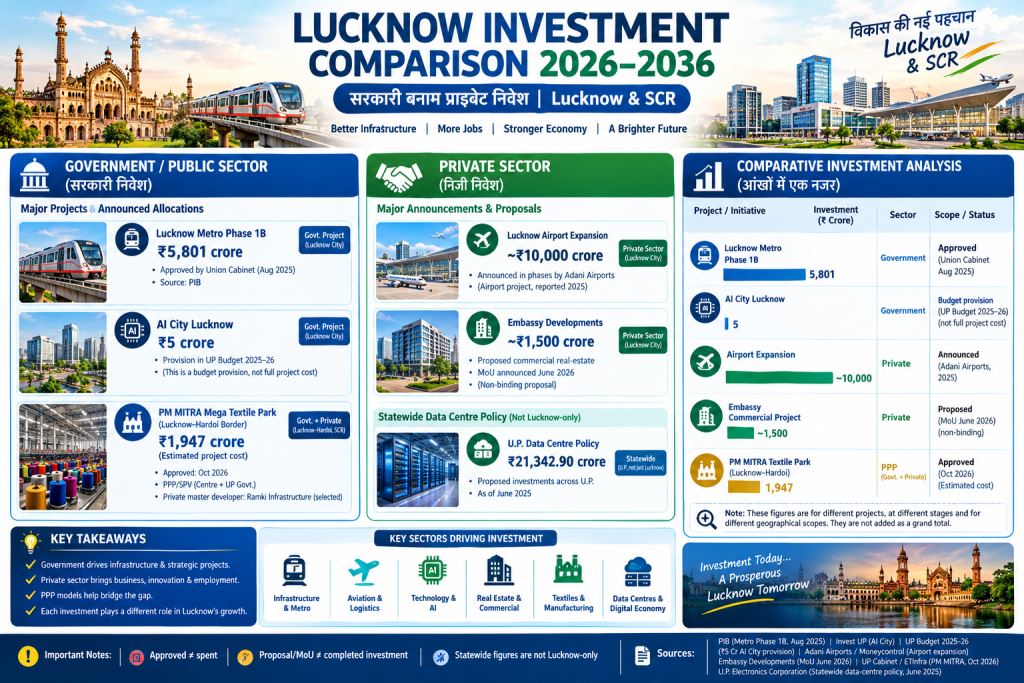
Lucknow Metro's first operational corridor, approximately 22.88 km long, was completed in March 2019. In August 2025, the Union Cabinet approved Phase 1B, a further 11.165 km with 12 stations, at an estimated cost of ₹5,801 crore. The extension is intended to improve connectivity to older and densely populated parts of the city. Economic effect: Better access to employment, retail, education and residential areas, provided last-mile connections and feeder transport develop alongside the metro.
B. Airport expansion and aviation-related investment
The airport's new integrated terminal programme and runway improvements have strengthened Lucknow's aviation infrastructure. The Airports Authority of India records a ₹1,383 crore cost for the new integrated terminal building project. In August 2025, Adani Airports separately reported a longer-term ₹10,000 crore expansion plan, with passenger capacity targeted to reach 14 million annually by FY 2026–27. That figure is a company-reported plan, not proof that the full amount has already been spent. Economic effect: Greater potential for tourism, business travel, air cargo, hospitality, hotels, cold-chain logistics and export-oriented enterprises.
C. Expressways and regional economic corridors
The Agra–Lucknow Expressway and Purvanchal Expressway have strengthened Lucknow's connections to other parts of Uttar Pradesh. Additional regional road links, including the Lucknow–Kanpur corridor, can improve access to manufacturing, markets and logistics facilities.
Economic effect: The strongest benefits occur when expressways connect to industrial estates, freight facilities, local roads and employment centres rather than functioning only as high-speed through-routes.
D. Commercial districts and organised housing
Gomti Nagar, Gomti Nagar Extension, Shaheed Path, Sultanpur Road, Raebareli Road and other growth corridors have attracted residential, commercial, institutional and mixed-use development. This has expanded the city's real-estate market and improved the supply of organised residential communities. However, individual projects differ substantially in approvals, occupancy, infrastructure and actual market demand.
Government investment in industrial infrastructure
The Uttar Pradesh State Industrial Development Authority (UPSIDA) approved a budget of ₹6,190 crore for FY 2025–26. This is an authority-wide budget, not a Lucknow-only allocation. The programme included industrial-area development and work related to the former Lucknow Industrial Development Area master plan.
This institutional investment matters because private factories and offices need more than cheap land. They require reliable power, water, roads, sewage treatment, telecommunications, clear land titles, environmental permissions and predictable approvals.
The State Capital Region investment ambition
In July 2024, reporting on the SCR initiative cited a proposed government investment of ₹5 trillion (₹5 lakh crore) to develop the region. This was an announced investment ambition, not a verified total of completed expenditure or a guarantee that the entire amount would be delivered within the originally discussed period.
A subsequent milestone came in September 2026, when the SCR review committee approved a regional base map and the next step was reported to be preparation of a GIS-based regional master plan. The reported area in that update was approximately 26,741 sq km, illustrating why official boundaries and planning documents should be checked against the latest notified records.
The region is therefore moving from the legislative framework toward more detailed spatial planning. The next test will be whether plans become funded, time-bound and coordinated projects.
3. Government investment priorities for 2026–2036
The coming decade is likely to be the most important period for establishing the foundations of the SCR. The priorities below combine formally reported projects with recommended planning directions; they should not all be interpreted as sanctioned projects.
Investment area | Main government entities | Expected development contribution |
|---|---|---|
Regional master planning | UP-SCR Development Authority, Housing and Urban Planning Department | Coordinated land use, new growth centres and infrastructure corridors |
Roads and expressways | NHAI, UPEIDA, state PWD | Faster regional travel and improved freight movement |
Metro and urban mobility | Uttar Pradesh Metro Rail Corporation, urban local bodies | Public transport, transit-oriented development and reduced congestion |
Residential townships | Lucknow Development Authority (LDA), housing agencies | Planned housing, parks, roads and civic services |
Industrial estates | UPSIDA, Invest UP | Industrial land, utilities and investment facilitation |
Airport and logistics | Airports Authority of India, airport concessionaire, logistics operators | Passenger travel, cargo, warehousing and trade |
Digital infrastructure | IT and Electronics Department, Invest UP, private technology companies | AI, data centres, software services and digital employment |
Water and environment | Jal Nigam, municipal authorities and relevant departments | Water security, drainage, wastewater treatment and climate resilience |
The AI City and IT City opportunity
One of the most significant emerging proposals is an AI-focused technology ecosystem in Lucknow.
Invest UP describes a proposed AI City at Vrindavan Yojana IT City, with Phase I planned on more than 20 acres. The broader development description includes office space, incubation, AI and deep-tech workspaces, computing facilities, testing laboratories and supporting commercial uses. These are planned components, not evidence that every facility is operational.
Separately, reporting in July 2025 described a ₹10,732 crore AI ecosystem funding announcement associated with the IndiaAI Mission, including plans involving computing capacity, language models and an AI innovation centre. That reported figure should not automatically be treated as a dedicated, fully committed Lucknow construction budget.
The larger economic opportunity lies in attracting companies that actually use this infrastructure:
- Software development, AI services and enterprise technology.
- Cybersecurity, cloud computing and data analytics.
- AI-assisted healthcare, education and public services.
- Start-ups, research laboratories and business incubators.
- Training, certification and professional services.
The SCR should aim to retain graduates and experienced professionals by creating high-quality jobs rather than depending entirely on property construction.
Lucknow–Kanpur economic corridor
The Lucknow–Kanpur corridor could become a major employment axis linking the capital's administrative and technology functions with the wider manufacturing economy around Kanpur and Unnao. UPSIDA's former-LIDA planning work and the proposed AI City have been discussed in the context of this corridor.
A successful corridor would require planned industrial land, reliable freight connections, employee housing, public transport, technical education and environmental safeguards. The recommended approach is to develop employment centres before encouraging uncontrolled ribbon development along highways.
Data centres and digital infrastructure
Uttar Pradesh's data-centre programme illustrates the scale of private capital that digital infrastructure can attract. The state's Electronics Corporation website reported, as of June 2025, proposed investments of approximately ₹21,342.90 crore and proposed capacity of 644 MW under the policy statistics it published. These are statewide figures, not investments confined to Lucknow.
For Lucknow, future opportunities include:
- Enterprise cloud and disaster-recovery facilities.
- AI computing and data analytics.
- Managed IT services and cybersecurity.
- Fibre networks and high-availability power infrastructure.
- Data-centre maintenance, engineering and specialist services.
The key constraint is the availability of dependable power, cooling, water-efficient technology and network redundancy. Data-centre investment should be matched by infrastructure capacity and environmental planning.
4. Private-sector investment: the next phase of Lucknow's growth
Government investment creates the framework, but private companies create much of the employment, commercial activity and recurring economic demand that sustain a city.
Over the next 10–30 years, the most important question will be whether Lucknow attracts productive businesses alongside residential and commercial real estate development.
1. IT, AI and technology companies
Potential investment areas: software development, AI services, cloud computing, fintech, cybersecurity, global capability centres and business-process services.
Potential private participants: Indian IT service providers, international technology firms, start-ups, telecom operators, cloud providers and venture-funded companies.
Planning opportunity: create a connected technology district around suitable IT City and commercial locations, with high-speed connectivity, reliable electricity, employee housing, public transport and training institutions.
Expected benefit: skilled employment and demand for offices, rental apartments, restaurants, hotels and professional services.
2. Healthcare, medical education and biotechnology
Private hospital groups, diagnostic networks, medical colleges, pharmaceutical distributors and healthcare technology companies could expand alongside public healthcare infrastructure. Opportunities include super-specialty hospitals, rehabilitation centres, medical laboratories, medical-device services, telemedicine and clinical research.
Planning opportunity: coordinate hospital locations with road access, emergency transport, housing for medical staff and biomedical waste treatment. Expected benefit: skilled jobs, regional medical tourism, educational demand and supporting commercial development.
3. Manufacturing, engineering and defence-related industries
The Uttar Pradesh Defence Industrial Corridor includes Lucknow among its six nodes, alongside Kanpur, Jhansi, Agra, Aligarh and Chitrakoot. The programme is intended to develop defence manufacturing and associated supply chains.
Potential private investments include precision engineering, electronics, components, industrial software, testing facilities and maintenance services. Planning opportunity: strengthen links between defence-sector suppliers, technical institutes, engineering companies and industrial estates. Expected benefit: manufacturing employment, supplier development, technical training and demand for industrial property.
4. Logistics, warehousing and e-commerce
Logistics operators, e-commerce companies, transport firms, cold-chain providers and third-party distribution businesses could benefit from improved regional connectivity.
Planning opportunity: locate freight terminals, warehouses, truck facilities and industrial storage in properly zoned areas with good road access rather than allowing unplanned development on agricultural land. Expected benefit: jobs in transport, inventory management, packaging, distribution and supply-chain technology.
5. Real estate, housing and commercial development
Private developers could expand apartments, independent houses, integrated townships, office buildings, shopping centres, hotels, rental housing and industrial parks. Potential participants include established national developers, regional builders, institutional investors, real-estate investment trusts where suitable, and private land-development companies.
Planning opportunity: align new housing supply with employment centres, utilities, public transport, schools, healthcare and environmental capacity. Expected benefit: more housing choices and construction-related employment. Long-term returns will depend on actual demand, affordability, title quality, project delivery and rental income.
6. Food processing and agricultural industries
Food-processing companies, dairy businesses, cold-storage operators, agricultural supply-chain firms and packaging manufacturers could invest in the wider SCR. Hardoi, Sitapur, Barabanki, Unnao and Rae Bareli have the potential to contribute through appropriate agricultural and industrial activities, subject to local resources and market feasibility.
Planning opportunity: establish processing and storage facilities near suitable production areas, with reliable power, water, testing laboratories and distribution access. Expected benefit: value addition to agricultural produce, rural employment and lower post-harvest losses.
5. Where should future investment be concentrated?
The following is a proposed regional development framework, not a notified government land-use map. The final locations must follow the approved regional master plan, infrastructure capacity and environmental clearances.
The map identifies existing geographic reference points for the proposed strategy. It does not show approved industrial zones, project boundaries or an official SCR master plan.
Growth corridor or district | Proposed economic focus | Infrastructure required |
|---|---|---|
Gomti Nagar and established commercial districts | IT, finance, offices, healthcare and services | Public transport, commercial utilities and urban mobility |
Vrindavan Yojana and IT City area | AI, software, research and technology offices | Digital connectivity, reliable power, public transport and utilities |
Sultanpur Road and suitable adjoining planned areas | Technology campuses, housing and mixed-use development | Master-planned roads, drainage, water and employment access |
Shaheed Path and connected growth areas | Residential, institutional and commercial development | Junction management, feeder roads, public transport and drainage |
Unnao and the Lucknow–Kanpur corridor | Manufacturing, logistics and engineering | Industrial utilities, freight links and worker housing |
Barabanki and suitable regional locations | Food processing, warehousing and regional services | Industrial land, road connectivity, water and cold-chain facilities |
Hardoi and Sitapur | Agriculture-linked industry, processing and regional urban centres | Local roads, electricity, skills, water and market access |
Rae Bareli and its suitable industrial locations | Engineering, manufacturing and regional services | Industrial infrastructure, skills and transport links |
The objective should be to create multiple employment centres instead of concentrating all offices, industries and population in Lucknow city.
6. A 30-year investment roadmap: 2026–2056
The next three decades can be divided into three planning phases. These phases describe a recommended development strategy, not a commitment that every proposed project will be undertaken.
Phase I: 2026–2036
Foundation decade
Main objective: establish the regional infrastructure and employment base.
- Complete and implement the SCR regional master-planning process
- Prioritise funded road, metro, drainage, water and public-transport projects.
- Advance the planned IT City and AI ecosystem, subject to project approvals and execution.
- Attract manufacturing, logistics, healthcare and technology employers.
- Develop planned housing near jobs and transport corridors.
- Improve industrial estates and the ease of doing business.
Measure of success: more operational businesses, formal employment, reliable infrastructure and completed projects—not merely announcements or land transactions.
Phase II: 2036–2046
Regional expansion
Main objective: transform infrastructure into a diversified regional economy.
- Expand successful industrial clusters and supplier networks.
- Strengthen AI, digital services, electronics and engineering.
- Develop regional medical, education, research and training hubs.
- Connect regional towns with reliable public transport and freight systems.
- Encourage rental housing and mixed-use development near employment.
- Modernise water recycling, waste treatment and renewable energy systems.
Measure of success: sustained productivity growth, a broader employment base, stronger district economies and improved access to essential services.
Phase III: 2046–2056
Mature regional economy
Main objective: establish a resilient, well-connected capital region.
- Upgrade transport, energy and digital networks for higher demand.
- Expand research-led industries and high-value services.
- Redevelop ageing urban areas rather than relying only on outward expansion.
- Create climate-resilient housing, flood management and water security.
- Strengthen regional economic specialisation and connections with other major Indian markets.
- Make public spaces, healthcare, education and mobility accessible across income groups.
Measure of success: a productive and liveable region with diversified jobs, dependable public services and manageable environmental pressures.
7. How government and private entities can coordinate investment
Successful regional development requires clear responsibility for planning, funding, execution and maintenance.
Entity | Proposed role in the SCR's long-term growth |
|---|---|
Government of Uttar Pradesh | Regional policy, budget allocations, industrial incentives and interdepartmental coordination |
UP-SCR Development Authority | Regional planning, coordination of infrastructure and alignment of development schemes |
LDA | Planned urban development, housing, land-use implementation and suitable new growth areas |
UPSIDA | Industrial land, estate infrastructure and facilitation of industrial projects |
UPEIDA and NHAI | Expressways, highway infrastructure and economic connectivity |
Uttar Pradesh Metro Rail Corporation and urban transport agencies | Metro expansion, multimodal connectivity and transit integration |
Invest UP and relevant departments | Investor facilitation, project coordination and investment promotion |
Airports Authority of India and airport concessionaire | Aviation connectivity, airport development and cargo-related facilities |
Private developers and infrastructure operators | Housing, commercial spaces, utilities and eligible public-private partnership projects |
Banks, institutional investors and financial institutions | Project finance, industrial credit, housing finance and infrastructure funding |
Universities and technical institutes | Skilled workforce, research, innovation and industry collaboration |
A practical delivery model should identify one accountable implementing agency for every major project, a confirmed funding source, land and clearance status, construction milestones and a public progress report.
Private participation can be encouraged through transparent land allotments, competitive procurement, appropriate public-private partnerships and predictable regulations. The government should avoid treating memoranda of understanding as completed investments until financing, approvals, construction and operations are verified.
8. How much investment could the SCR require by 2056?
No reliable, fully funded 30-year investment total for the complete SCR can be established from the announcements cited in this report. A more useful approach is to distinguish actual government expenditure, committed private investment, announced proposals and future infrastructure requirements. The following is an illustrative planning exercise, not an official forecast or government target.
SCR investment scenario calculator
Adjust the hypothetical first-year investment and annual growth rate to explore a 30-year funding scenario. Amounts are in ₹ crore at nominal values; inflation is not deducted.
Investment in the first year
₹50,000 Cr
₹10,000 Cr
₹50,000 Cr
₹1 lakh Cr
Annual investment growth
5%
0%
5%
10%
Illustrative public-sector share
40%
20%
50%
80%
Cumulative 30-year investment scenario
₹33.22 lakh crore
Total of the hypothetical annual investments, without discounting for inflation or time value.
Public-sector scenario
₹13.29 lakh Cr
Private-sector scenario
₹19.93 lakh Cr
Model: first-year amount × (1 + annual growth rate)^year, summed over 30 years. The public/private split is an assumption, not an observed or recommended funding ratio. This scenario must not be represented as a sanctioned SCR investment estimate.
The actual regional requirement should be calculated from a bottom-up infrastructure plan covering roads, public transport, power, water, sewage, industrial estates, housing, healthcare, education and climate resilience. It should also distinguish new capital spending from operating costs and maintenance.
9. What this transformation could mean for the real-estate market
For property owners, developers and investors, the SCR creates potential opportunities—but it does not make every plot or township a good investment.
Potential opportunities
- Residential property: locations with completed roads, utilities, employment access and genuine end-user demand.
- Commercial property: offices, shops, clinics and hospitality near operating employment centres and established residential catchments.
- Industrial land: properly approved sites with suitable power, freight connectivity, water and zoning.
- Warehousing: locations with efficient highway access, truck movement and proximity to real distribution demand.
- Rental housing: areas where businesses, hospitals, educational institutions and industrial clusters generate sustained employment.
- Agricultural land: potential for lawful agricultural or other permitted uses, subject to zoning, conversion rules and realistic demand.
Essential due diligence
Before purchasing land in Lucknow or any neighbouring SCR district, check:
- Title and ownership: verify the chain of title, encumbrances, land records and any litigation.
- Land-use status: establish whether the parcel is agricultural, residential, commercial, industrial or otherwise designated.
- Layout and approvals: verify the applicable development authority's approvals and sanctioned layout.
- RERA: check whether registration is required and, where applicable, verify the project on the official RERA portal.
- Road and infrastructure status: distinguish a completed public road from a proposed alignment or an unconfirmed access route.
- SCR planning status: verify the latest notified regional plan and any applicable restrictions. Inclusion in the broad SCR region alone does not make land approved for plotting or construction.
- Price and exit strategy: compare actual transactions, available supply, rental yields, holding costs and the likely resale market.
A location near a proposed highway, AI City or industrial corridor may attract speculative interest, but prices can remain stagnant for years if a project is delayed, demand fails to materialise or infrastructure does not reach the site.
10. Major risks that could affect development through 2056
The SCR's long-term success will depend as much on managing constraints as on attracting investment.
- Unplanned urban sprawl: development that proceeds without adequate roads, drainage, water supply or public transport.
- Water and flood risk: groundwater depletion, inadequate drainage, flooding and the loss of natural water bodies.
- Weak employment creation: property development without a matching increase in productive businesses.
- Project delays: land acquisition disputes, financing gaps, approvals and construction problems.
- Speculative land pricing: rates rising faster than household incomes, rents and underlying economic activity.
- Uneven district development: investment concentrating in a few corridors while other districts receive limited economic benefits.
- Environmental degradation: loss of agricultural land, green spaces and natural drainage systems without suitable safeguards.
- Fiscal and maintenance pressures: new infrastructure that cannot be adequately maintained over its useful life.
The regional planning process should include flood-risk mapping, water budgeting, environmental safeguards, affordable housing, public transport and periodic reviews of employment and population growth.
11. Final outlook: Lucknow and the SCR in 2056
Lucknow's future development will be determined by whether the region can convert infrastructure spending and private investment announcements into productive, functioning economic assets.
The first priority for 2026–2036 should be to build a coordinated regional planning system, deliver essential infrastructure and attract employment-generating industries. From 2036–2046, the focus should shift toward industrial diversification, research, skilled employment and stronger regional towns. From 2046–2056, the goal should be a mature economic region with resilient infrastructure, efficient mobility, reliable utilities and sustainable urban growth.
The strongest long-term model is one in which:
- Lucknow remains the administrative, financial, healthcare, education and technology centre.
- Neighbouring districts develop suitable manufacturing, logistics, agricultural processing and supporting urban economies.
- Private developers supply housing and commercial property in response to actual demand.
- Public investment supports connectivity, essential services and environmental protection.
- Universities, businesses and government agencies work together to create skilled employment.
- Infrastructure and land-use decisions are guided by transparent regional plans rather than speculation.
The central conclusion: the State Capital Region offers Lucknow an opportunity to become a much larger and more diversified economic region by 2056. But its success will be measured not by the number of announced projects or the rise in land prices, but by completed infrastructure, productive investment, sustainable employment, better public services and a higher quality of life across all six districts.
Sources and further reading
The following sources provide a starting point for tracking official plans, budgets and project announcements. The status of individual projects should be rechecked before publishing specific investment amounts or completion dates.
Uttar Pradesh State Capital Region and Other Regions Development Authority Act, 2024 — statutory framework.
Business Standard: ₹5 trillion SCR investment ambition — reported government investment plan.
Invest UP: AI City Lucknow — proposed AI and technology ecosystem.
UPEIDA: Uttar Pradesh Defence Industrial Corridor — corridor nodes and programme information.
Uttar Pradesh Budget Portal — state budget documents and sector allocations.
Press Information Bureau: Lucknow Metro Phase 1B approval — approved metro expansion and reported cost.
U.P. Electronics Corporation: Data Centre Policy — policy statistics and proposed digital infrastructure investments.
Airports Authority of India: Lucknow Airport — airport concession and development information.
Editorial note: This article is suitable as a foundation for a detailed Lucknow–SCR investment research report. Before using it as a definitive government-project inventory, add the latest notified SCR regional master plan, project-wise administrative approvals, funding allocations, tender status and completion data as they become available.



Leave a Comment