
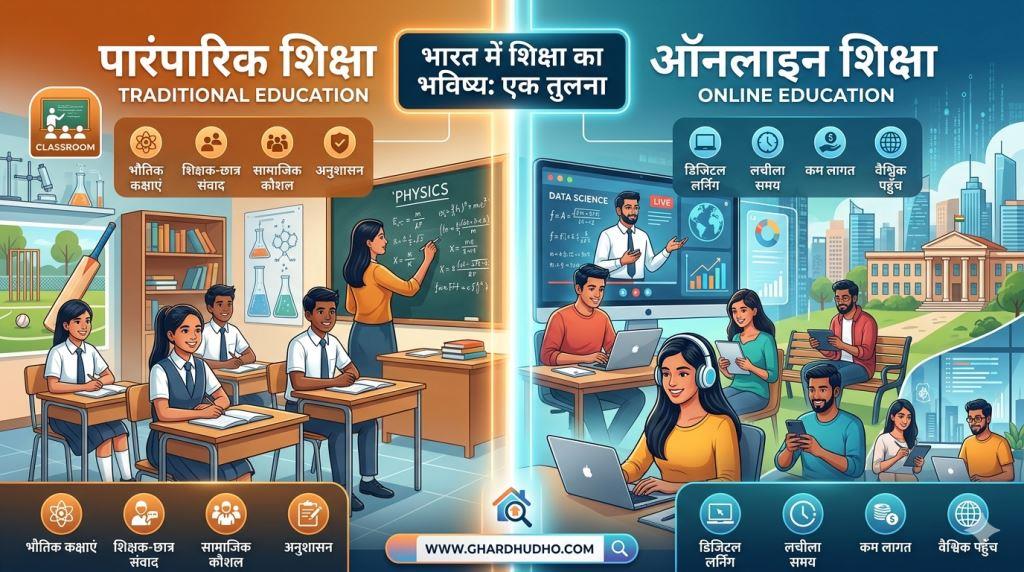
The landscape of education in India has undergone rapid transformation over the past few years. While traditional education remains deeply rooted in our culture, online education has, conversely, opened up new avenues for the future through the power of technology. Presented below is a comparative overview of both systems, along with their respective market statistics:
Traditional Education
This system is based on physical classrooms, face-to-face interaction with teachers, and social engagement.
- Features: Discipline, laboratory experience, sports, and co-curricular activities.
- Challenges: High fees, geographical constraints, and lack of infrastructure.
Market Cap – Traditional Education
- Current Status (2025-26): The traditional market for school and higher education in India is estimated to be between approximately USD 135 billion and USD 140 billion.
- Future Projection (2030-34): This market is projected to reach USD 341 billion (by 2030). Its Compound Annual Growth Rate (CAGR) is expected to range from approximately 10% to 12%.
Online Education In India
Online education (EdTech) has emerged as one of India's most dynamic sectors today. The accessibility of technology and the internet has transformed it from a niche alternative into a massive industry. Presented here is a detailed overview of the current market, future prospects, and statistics regarding online education:
The 'Digital India' initiative and affordable internet rates have enabled it to reach every household. It utilizes video lectures, live classes, and AI-based learning.
- Features: Low cost, flexible scheduling, and access to excellent educators.
- Challenges: The 'Digital Divide' (internet connectivity issues in rural areas) and a lack of social interaction.
Market Cap – Online Education
- Current Status (2025-26): India's online education market currently stands between approximately USD 3.6 billion and USD 5.3 billion.
- Future Projection (by 2034): Experts believe that this market could reach anywhere from USD 23.9 billion to USD 36 billion.
- Growth Rate: The online sector is experiencing rapid growth, expanding at a pace of approximately 23.2% (CAGR).
1. Current Market Cap in India
India currently holds the position of being the world's second-largest online education market.
- Value in Rupees: According to estimates for 2025-26, India's EdTech market is valued at approximately ₹35,000 crore to ₹45,000 crore (roughly $4.2 – $5.3 billion).
- Key Segments: The largest share of this market is held by 'K-12' (school education), competitive exam preparation (Test Prep), and skill development (Upskilling).
2. Future Market Cap and Projections
Unprecedented growth is expected in the online education sector over the next decade.
- 2030–2034 Projection: According to experts, by 2030, this market could reach a valuation of ₹2,50,000 crore to ₹3,00,000 crore ($30 – $36 billion).
- Growth Rate (CAGR): This sector possesses the potential to grow at an annual rate of approximately 23% to 25%.
3. Online vs. Offline: Market Share Ratio
The share of online education (Market Penetration) within the total education market is growing rapidly:
- Current Ratio: Currently, the contribution of online education to the total Indian education market (valued at approximately $140 billion) stands at a mere 3.5% to 5%.
- Future Ratio (by 2030): Driven by the increasing influence of technology and the adoption of hybrid models, this share is projected to rise to between 15% and 20%. In other words, for every ₹100 spent on education, ₹20 will be spent through online mediums.
Comparative Statistics (Facts & Figures)
| Feature | Traditional Education | Online Education |
|---|---|---|
| Current Market (2025/26) | $135-140 Billion | $5.3 Billion |
| Projected Market (2030-34) | $341 Billion (2030) | $36 Billion (2034) |
| Annual Growth Rate (CAGR) | 10% - 12% | 23.2% |
| Key Drivers | Population, Government Investment, NEP 2020 | Smartphones, AI, Affordable Internet Rates |
| Reach | Local | (Global |
4. Future Scope and Opportunities
The future of online education is not limited merely to video lectures; it is expanding to encompass several new dimensions:
- AI-Personalized Learning: Artificial Intelligence will identify a student's specific strengths and weaknesses to provide them with a personalized learning path.
- Gamification: For young children, the learning process is being designed to resemble a game in order to sustain their interest and engagement.
- The Rise of Tier 2 & Tier 3 Cities: Real growth is now shifting away from metropolitan areas and reaching smaller cities and towns, where high-quality coaching facilities are currently scarce.
- Corporate Training: Companies will extensively utilize online platforms to impart new skills (such as AI and Data Science) to their employees.
- VR/AR (Virtual Reality): Through virtual laboratories, students will be able to experience scientific experiments or medical surgeries from the comfort of their own homes.
Quick Facts at a Glance
| Details | Current (2026 Estimate) | Future (2030-34 Estimate) |
| Market Value (₹ Crores) | ₹40,000 Crores | ₹3,00,000 Crores |
| User Base | 12 Crores+ | 25 Crores+ |
| Total Market Share | 4% - 5% | 15% - 20% |
| Primary Focus | Coding, Test Prep, K-12 | AI, VR, Vocational Training |
Online education is no longer merely a "temporary alternative," but has evolved into a permanent pillar of the Indian education system. It is not only significant from a commercial standpoint but also serves as the most effective medium for delivering education to the remotest corners of the country.
The future belongs to the 'Hybrid Model,' wherein schools and colleges will integrate technology into their academic curricula. While traditional education retains its own inherent limitations and significance, online education has established a strong foothold in the realms of skill development and competitive examinations. By 2030, India is poised to emerge as one of the world's largest educational hubs.
'Hybrid Model':
The Hybrid Model (Hybrid Learning) is a modern educational approach that represents a balanced blend of the traditional 'chalk-and-talk' method and modern digital tools. It is also known as 'Blended Learning.' Simply put, it involves students attending school for in-person instruction while simultaneously learning through digital platforms at their own convenience.
Key Pillars (Components) of the Hybrid Model:
In-person Learning: Students attend school or college to engage in direct interaction with teachers, conduct experiments, and develop social skills.
Online Component: Students can study anytime and anywhere using resources such as recorded videos, e-books, and online quizzes.
Interactive Technology: Understanding complex subjects through the use of smart boards, AI-based learning apps, and Virtual Reality (VR).
How Does the Hybrid Model Work?
1. Flipped Classroom
In this approach, students study new topics at home using videos or digital notes. School time is utilized for discussing the topic, clarifying doubts, and engaging in project work.
2. Rotation Model
Students are divided into small groups. At any given time, one group learns directly from the teacher, a second works on online modules, and a third engages in lab work or group activities.
3. Flex Model
Here, the primary instruction takes place online; however, teachers remain present as "mentors" to provide personalized assistance to students whenever and wherever needed.
Benefits and Future Statistics of the Hybrid Model
Benefits:
- Flexibility: Students can learn at their own pace.
- Enhanced Data Tracking: Educators can closely analyze the progress of each student using online tools.
- Cost Reduction: Infrastructure costs for institutions and commuting expenses for students are reduced.
Future Statistics and Trends:
- The Future of Education: According to a report, by 2027, more than 70% of India's premium educational institutions will have fully adopted the hybrid model.
- Impact of NEP 2020: The New Education Policy (NEP) emphasizes digital literacy, thereby providing the hybrid model with government recognition and encouragement.
- Market Share: It is estimated that in the future, the market share of purely offline education will decline, while the hybrid model will capture approximately 40% to 50% of the total education market.
The hybrid model has evolved from being merely an option into a necessity. By bridging the gap between "the four walls of the school" and "the limitless world of the internet," it creates an ecosystem that prepares students for the digital economy of the future.
From the perspective of investment or startups in the education sector, online education is a "Gold Mine"; however, to achieve success here, it is essential to understand its intricate nuances. Detailed below are the areas and strategies poised to yield the highest profits and growth in the future:
1. The Hottest Segments for Investment (High-Growth Segments)
If you wish to venture into this sector, these three areas offer the greatest potential:
A. Skill Upgradation and Re-skilling (Upskilling)
In today's corporate world, skills hold greater value than academic degrees.
- Scope: Short-term courses in AI, Machine Learning, Data Analytics, and Digital Marketing.
- Market: The target audience comprises not only college students but also working professionals aged 30–40.
B. Education in Local Languages (Vernacular EdTech)
The English-speaking population in India is limited. The true market lies with the 90% of the population that prefers to learn in languages such as Hindi, Marathi, Tamil, or Bengali.
- Opportunity: Providing preparation courses for government jobs (SSC, Banking, Railways) in local languages.
C. Micro-learning Platforms
People are no longer interested in watching two-hour-long videos. There is a growing trend toward short, effective educational videos—similar to 'Reels'—that last between 5 and 10 minutes.
2. Successful Business Models for Startups
| Model | Description | Revenue Method |
| B2C (Direct to Student) | Selling courses directly to students (e.g., Physics Wallah) | Subscriptions or Course Fees |
| B2B (To Schools/Colleges) | Selling software or content to schools | Annual License Fees |
| Freemium | Basic content is free, but tests and certificates require payment | Advertising and Premium Conversions |
3. Challenges to Avoid
Keep these points in mind before starting a startup or making an investment:
- High Customer Acquisition Cost (CAC): Acquiring students through advertisements on platforms like Facebook or Google proves to be very expensive. To achieve success, it is essential to build an 'organic community.'
- Content Fatigue: A vast amount of free content is already available in the market (e.g., on YouTube). People will only pay you if your content is both "Unique" and "Result-Oriented."
- Retention: Students often purchase courses but fail to complete them. Keeping them engaged—potentially by leveraging AI—presents a significant challenge.
4. Future Technologies: Where to Invest?
- AI-Tutors: Bots capable of solving students' math problems, even at 2:00 AM.
- VR Labs: Providing practical science and engineering experiences at a low cost.
- Blockchain Certification: Blockchain-based certificates designed to prevent fraudulent degrees.
Conclusion and Advice
Over the next five years, 'Hybrid EdTech' (combining online learning with offline centers) is poised to be the most successful model. If you are looking to invest, focus on companies that prioritize "Student Results" rather than merely focusing on technology.



Leave a Comment