
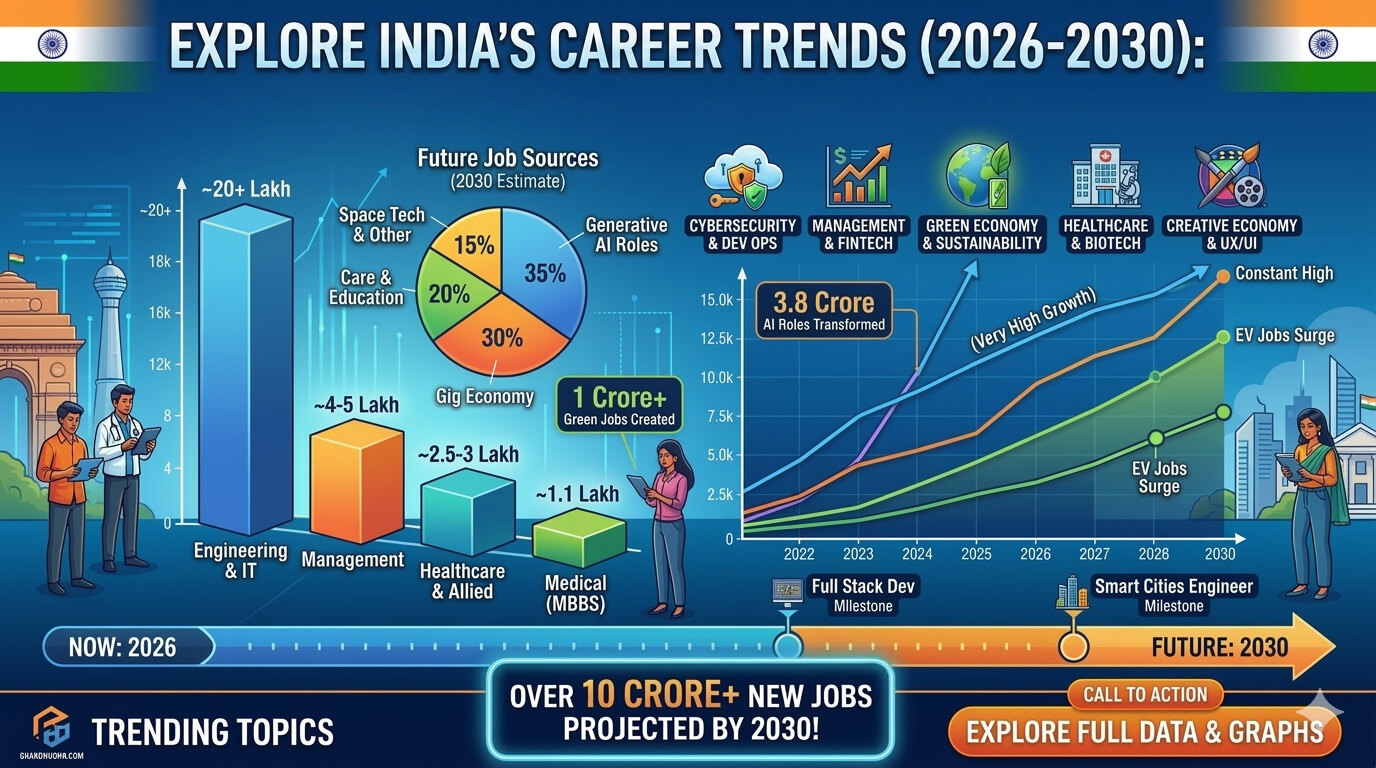
In the current landscape of 2026, India's education and employment sectors are undergoing a major transformation. The demand is no longer solely for academic degrees, but rather for skill-based, specialized courses. The data and analysis provided below offer comprehensive insights into every sector:
1. Demand for Courses in the Education Sector (Current vs. Future)
In today's landscape, the integration of Technology and Management reigns supreme.
| Course Category | Current Demand (2026) | Future Prospect (2030) | Why? |
|---|---|---|---|
| AI & Data Science | Very High | Dominant Sector | Automation and personalized AI are ubiquitous. |
| Cybersecurity | High | Critical | The surge in digital transactions has created a shortage of security experts. |
| Management (BBA/MBA) | High | Moderate-High | There is a shift towards Digital Marketing and Business Analytics. |
| Healthcare (B.Sc/MBBS) | Consistently High | Increasing | Driven by an aging population and growth in health-tech. |
| Sustainability/Green Energy | Emerging | Very High | Due to climate change and Electric Vehicles (EVs). |
2. Pan India Seat Allotment (Rough Estimates)
Seat allotment in India is regulated by the AICTE and the UGC. The tentative data for the 2025-26 academic session is as follows:
| Engineering (B.E./B.Tech) | There are approximately 1.5 million (15 Lakh) seats across India. Among these, branches such as AI, ML, and Data Science have witnessed an increase in seat availability of up to 20%. |
| Medical (MBBS) | Approximately 110,000 (1.1 Lakh) seats (Government + Private). In this sector, demand consistently exceeds supply. |
| Management (MBA/PGDM) | Approximately 400,000 (4 Lakh) seats. |
| Pharmacy & Allied Health | Approximately 300,000 (3 Lakh) seats. |
3. What is the Demand for Various Roles in the Employment Sector?
The employment market has now shifted from favoring "Generalists" to prioritizing "Specialists."
- IT & Software: This sector accounts for the highest volume of hiring. However, instead of simple coding, the current demand is for Cloud Computing, DevOps, and Full Stack Development (integrated with AI).
- Data-Driven Roles: A growth of 35–40% has been observed in roles such as Data Analyst and Business Intelligence.
- BFSI (Banking & Finance): There is a massive demand for Fintech experts who possess an understanding of blockchain and digital banking.
- Creative Economy: UX/UI Design and Digital Content Creation have now become mainstream professions, with starting salary packages ranging from ₹6 to ₹12 LPA.
4. Which is the Most In-Demand Course?
If one were to name just one, it would be **B.Tech/BCA in Artificial Intelligence & Machine Learning**.
Why? Because it is not limited solely to the IT sector; its applications extend to Healthcare, Finance, Manufacturing, and even Agriculture.
Expert Note: In 2026, merely holding a degree is not enough. Modular Learning (short, specialized certificates) and Soft Skills (Critical Thinking, Leadership, Adaptability) are just as essential for employability as your degree itself.
Future Prospects (Vision up to 2030)
Over the next 4–5 years, significant job openings are also expected in "Green Jobs" (Renewable Energy) and "Space Tech". If you are a student, choose courses that are technology-driven but also offer scope for human empathy and creativity.
Considering the current scenario of 2026 and the future prospects leading up to 2030, the entire structure of education and employment in India is undergoing a transformation. "Specialized Skills" have now taken precedence over "General Degrees."
A detailed analysis, tailored to your query, is provided below:
1. Current Demand: Top Courses (2026 Scenario)
Engineering and IT are still at the top, but their underlying branches have changed.
| Course | Current Demand Status | Primary Employment Sector |
|---|---|---|
| B.Tech (AI & Data Science) | Extremely High | Tech Giants (Google, Microsoft), Startups, BFSI |
| Cybersecurity & Ethical Hacking | High | Banking, Defense, E-commerce, IT Services |
| MBA (Business Analytics/Fintech) | High | Strategic Consulting, Financial Institutions |
| B.Sc/M.Sc (Biotechnology) | Emerging High | Pharma, R&D, Healthcare GCCs |
| Digital Marketing & UX/UI Design | Very High | E-commerce, Advertising, Product Companies |
| B.Com (Applied Finance/GST/CA) | Steady High | Accounting, Tax Consultancy, Fintech |
2. Employment Demand: Course-Wise Jobs
According to current hiring trends, here is a breakdown of the jobs available for specific courses:
Tech & Engineering: In 2026, a 34% surge was observed in AI/ML roles. The highest demand is no longer just for "Coders," but specifically for Cloud Architects and Full Stack Developers (Salary Range: ₹6L - ₹20L LPA).
Healthcare & MedTech: India is home to over 150 Healthcare Global Capability Centres (GCCs), which collectively employ approximately 300,000 professionals. Job opportunities in the fields of Biomedical and AI-driven healthcare are growing rapidly.
Management: Compared to a General MBA, placement rates are significantly higher in specialized fields such as Product Management and Supply Chain Management.
Commerce & Finance: Driven by the growth of Fintech and Digital Banking, there is a high demand for professionals who possess proficiency in data tools (such as Python and Tableau) in addition to their finance expertise.
3. Future Job Creation (2026 - 2030 Forecast)
Here is the forecast regarding the nature of jobs over the next 4-5 years:
Generative AI Impact: According to a report, by 2030, AI is expected to transform approximately 38 million (3.8 crore) jobs in India. This implies that there will be millions of jobs available for those who manage and operate AI systems (such as Prompt Engineers and AI Trainers).
Green Economy: The renewable energy (Solar, Wind) and Electric Vehicles (EV) sectors are expected to generate over 10 million (1 crore) new jobs by 2030. To capitalize on these opportunities, Mechanical and Electrical engineers will need to acquire "Green Skills."
Care Economy & Education: With India's growing population, jobs in caregiving, nursing, and online education (EdTech) will never be in short supply. This sector is projected to witness an annual growth rate of approximately 20-25%.
Gig Economy: By 2030, India is expected to have approximately 23 million (2.3 crore) freelance or gig workers. This signifies a shift where individuals will work on multiple projects rather than being employed by a single company.
Conclusion: Kaun sa course chune?
Agar aap future-proof career chahte hain, toh ye 3 raaste sabse behtar hain:
- AI/Data Science: Agar aapka interest math aur coding me hai.
- Renewable Energy/EV Engineering: Agar aap core engineering me rehna chahte hain.
- Digital Business & Design (UX/UI): Agar aap creative hain aur business samajhte hain.


Leave a Comment