
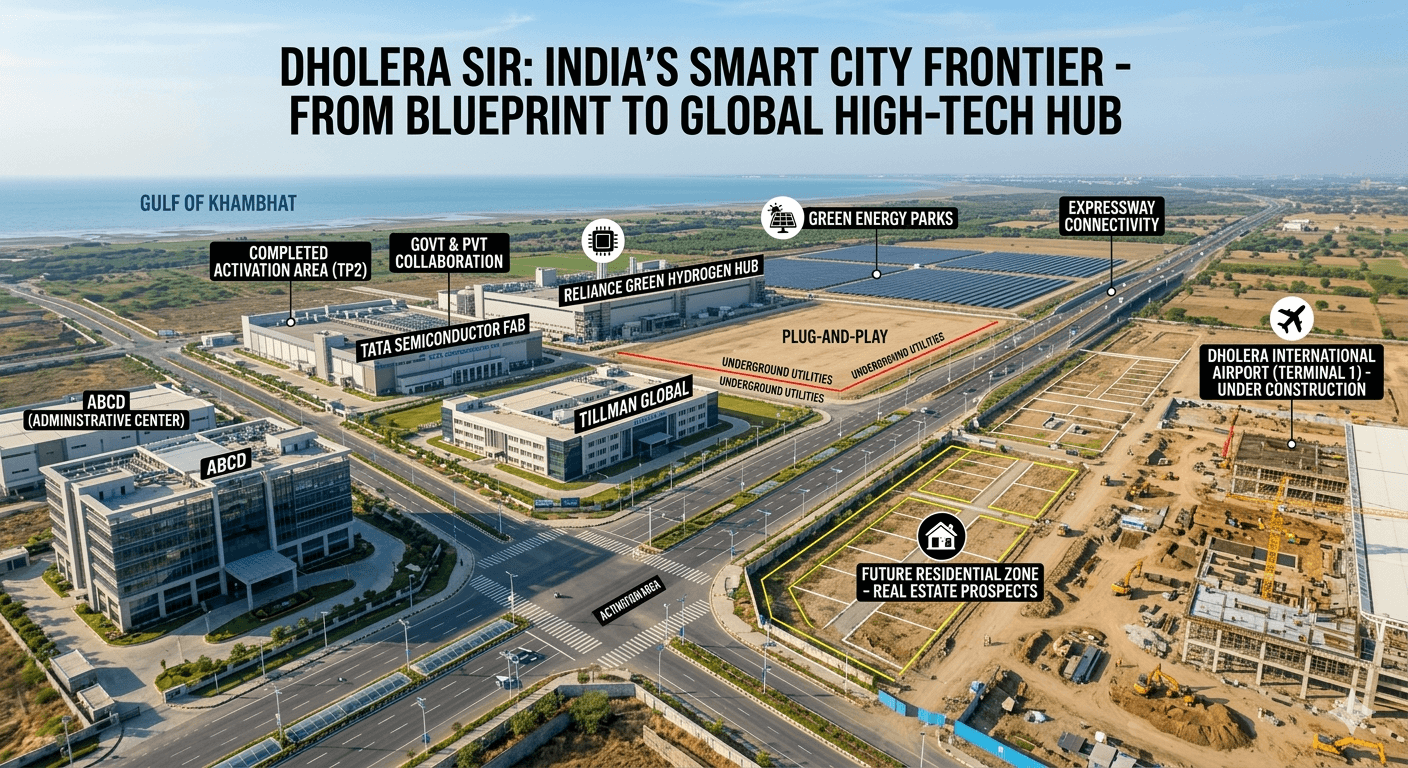
The Dholera Special Investment Region (SIR) has transitioned from a conceptual blueprint into India’s most significant "Plug-and-Play" ecosystem. As of early 2026, it stands as a 920 sq. km greenfield marvel, strategically positioned to become the "Semicon City" of India.
1. Development Analysis: Government vs. Private Sector
The development of Dholera is a masterclass in Public-Private Partnership (PPP). The government builds the "foundation," while the private sector builds the "engine."
A. Government Sector (The Foundation)
The Government of India and the Government of Gujarat have established Dholera Industrial City Development Ltd (DICDL) to oversee the project.
Infrastructure Spend: Over ₹3,000 Crore has been invested in the 22.5 sq. km Activation Area (TP2), which is now 100% complete with smart roads, underground sensor-based utilities, and 24 \times 7 water/power.
Connectivity Milestones (2025–2026):
- Ahmedabad–Dholera Expressway: The 109-km, 4-lane (expandable to 8) expressway is now operational, reducing travel time from Ahmedabad to 45 minutes.
- Dholera International Airport: Phase 1 is nearing completion (March 2026), designed to handle massive cargo and passenger traffic.
- Utility Excellence: A 5,000 MW Solar Park (one of the world's largest) provides subsidized, green power to industries.
B. Private Sector (The Engine)
With the infrastructure ready, global giants have committed over ₹6 Lakh Crore in investments.
| Investor | Investment (Approx.) | Sector / Project |
|---|---|---|
| Tata Electronics | ₹91,000 Crore | India’s first Mega Semiconductor Fab |
| Reliance Industries | ₹5.95 Lakh Crore | Green Energy & Hydrogen Hub (Gujarat-wide, Dholera focus) |
| Tillman Global | $10 Billion (~₹83k Cr) | Massive Data Center Campus |
| Tsingshan Group | ₹21,000 Crore | EV Battery & Steel Manufacturing |
| Tata Power | ₹4,000 Crore | Solar Power Plant & Infrastructure |
.jpg)
2. Economic Significance: India’s Growth Engine
Dholera SIR is not just a city; it is a strategic economic asset for India’s "Viksit Bharat 2047" vision.
- Global Supply Chain Pivot: By hosting semiconductor fabs and EV battery plants, Dholera reduces India's import dependency and positions the country as a global high-tech exporter.
- The DMIC Catalyst: As a node on the Delhi-Mumbai Industrial Corridor (DMIC), it provides seamless logistics via the Dedicated Freight Corridor (DFC).
- Employment Generation: The city is projected to create 8 Lakh+ jobs (26,000 direct and 1.25 Lakh indirect in the first phase alone).
- Sustainable Urbanism: It serves as a template for 100+ future smart cities, emphasizing zero-waste, green energy, and data-driven governance.

3. Real Estate: Future Prospects & Importance
The real estate market in Dholera has shifted from speculative (hope-based) to utility-driven (demand-based) as the first wave of employees arrives.
Why the Real Estate Sector is Critical:
- Workforce Housing: The influx of engineers and technicians for the Tata and NextGen plants is creating an immediate demand for rental and residential units.
- Asset Class Diversification: Dholera offers a "Greenfield Advantage." Unlike congested metros, land here is planned with clear zoning (Residential, Commercial, Industrial), reducing legal risks.
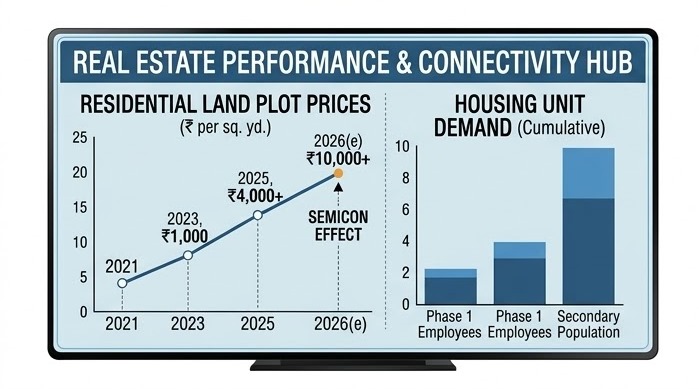
- Capital Appreciation: In 2026, plot prices range between ₹8,000 and ₹10,000 per sq. yard. Experts predict a 20-25% annual appreciation as the airport becomes fully operational.


Future Outlook (2026–2030):
- The "Semiconductor Effect": History shows that tech hubs (like Silicon Valley or Bengaluru) see exponential property value growth once the "anchor" industry starts production.
- Residential Maturity: We are seeing the rise of "Smart Gated Communities" featuring IoT-enabled security and sustainable architecture.
- Commercial Boom: High demand is expected for hotels, hospitals, and malls near the Airport Corridor and the ABCD (Administrative) Building.
- Key takeaway for investors: 2026 is the "Sweet Spot." The infrastructure is no longer a promise—it is visible on the ground—but prices have not yet reached the peak levels seen in mature cities like Ahmedabad or Surat.
Investment Comparison: Dholera vs. Other Indian Smart Hubs (2026 Data)
Comparison between Dholera SIR with other major Indian smart city hubs. Each of these cities serves a different economic purpose, making them unique investment vehicles.
| Feature | Dholera SIR (Gujarat) | GIFT City (Gandhinagar) | AURIC (Maharashtra) | NAINA (Navi Mumbai) |
| Primary Focus | Industrial & Manufacturing | Financial Services (IFSC) | Engineering & Pharma | Logistics & Residential |
| Total Area | 920 sq. km (Massive) | 886 acres (Compact) | 40 sq. km | 371 sq. km |
| Entry Price (2026) | ₹8,000–₹10,000 /sq. yard | ₹8,000–₹12,000 /sq. ft | Moderate (Industrial) | High (Metro-proximate) |
| Expected ROI | High (25%+ p.a.) | Stable (10-15% p.a.) | Moderate (12-15% p.a.) | High (Short-term) |
| Asset Class | Land Plots & Industrial | Commercial & Luxury Flats | Industrial Sheds | Apartments & Office |
| Key Advantage | Early-mover land banking | Immediate rental yields | Operational ready infra | Proximity to Mumbai |
| Best For | Wealth creation (10 yr+) | Monthly income/Cash flow | B2B Business owners | End-users/Commuters |
Strategic Analysis for Your Blog
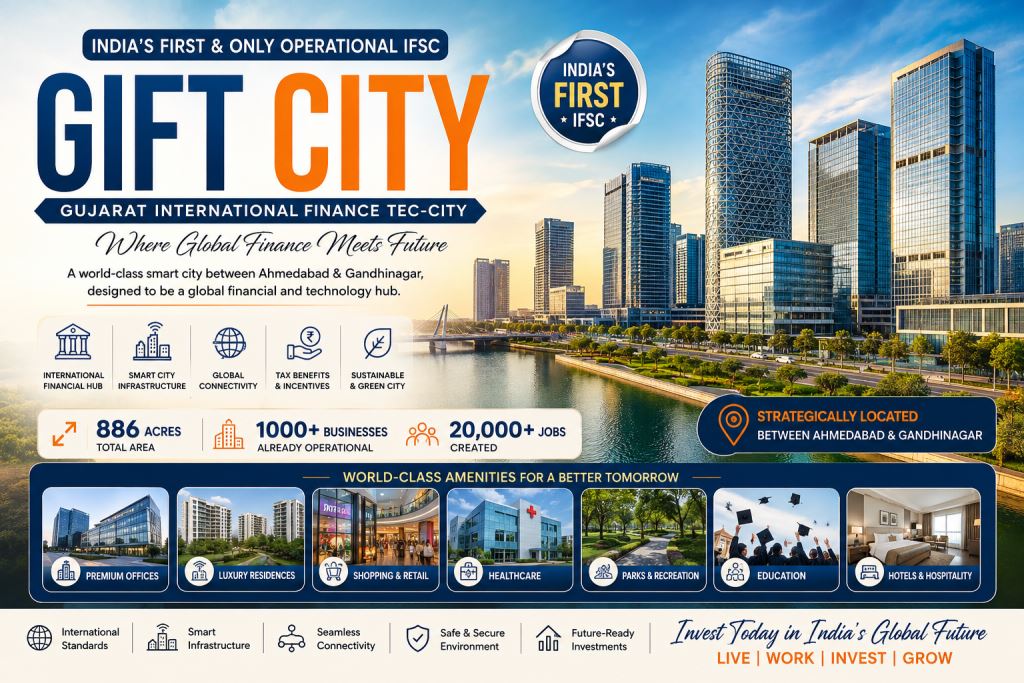
- Dholera vs. GIFT City: While both are in Gujarat, they are non-competing. GIFT City is India’s "Wall Street," focusing on vertical growth and high-end rentals. Dholera is India’s "Shenzhen," focusing on horizontal industrial expansion and massive capital appreciation of land.
- The "Semiconductor Premium": Dholera is currently seeing a price surge specifically because of the Tata-PSMC Fab and NextGen plants. In real estate terms, this is known as "Industrial Anchoring"—where one massive employer ensures the value of all surrounding residential land.
- Risk Profile: In 2026, the risk in Dholera has shifted from "Will it happen?" to "How fast can I build?" Since the basic infrastructure (roads, water, ICT) is now operational, the investment is no longer speculative but based on actual utility demand from the incoming workforce.
Why the "Real Estate Sector" is the Backbone?
While the Government builds the bones (roads/utilities) and Industries build the heart (jobs), the Real Estate sector provides the skin and muscle (housing, retail, hospitals). Without a robust real estate sector, a smart city remains a factory zone; with it, it becomes a living, breathing metropolis.


Leave a Comment